
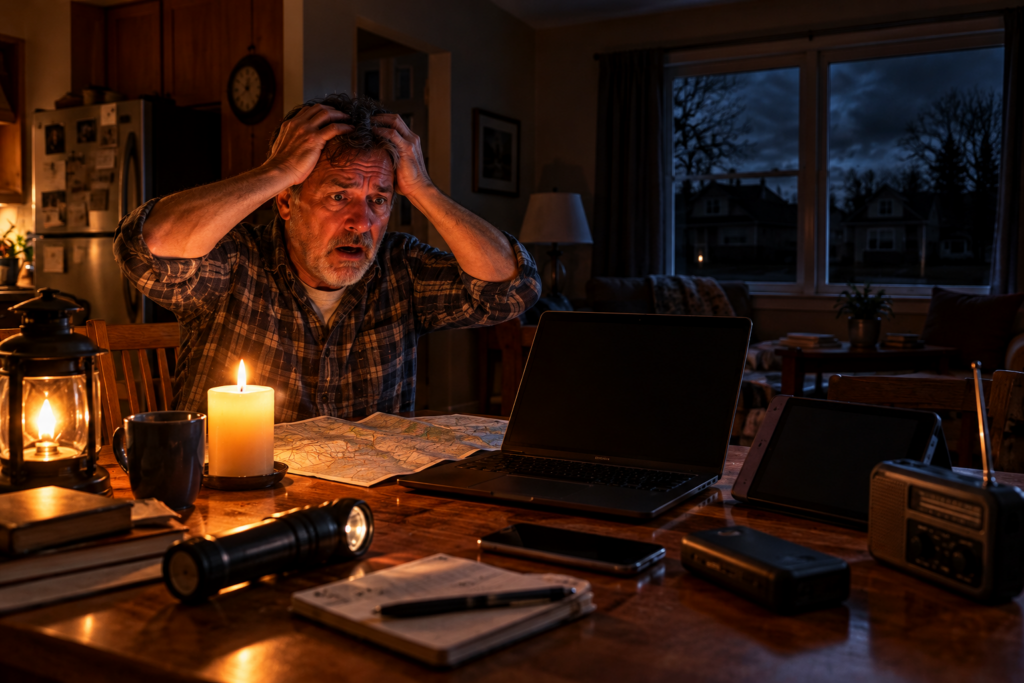
To some extent, we’ve all experienced a total loss of electrical power for short periods of time. But what if, God forbid, something catastrophic happened?
What if a massive solar event knocked out power grids around the world? Or an electromagnetic pulse (EMP) attack during a war caused widespread electrical and electronic failures?
Imagine a complete shutdown of the technology we depend on every day.
No cell towers. No internet. No ATMs. No working gas pumps. No electronic banking. No easy way to communicate with the outside world.
A complete breakdown of the technological systems that support our modern society.
Could you survive?
Think about all the survival skills we’ve lost as society has advanced and technology has made our lives easier.
How many of us know how to cook dinner over an open fire? Read a paper map without relying on GPS? Recognize which plants are safe to eat if we’re stranded in the wilderness? Can our own food to preserve it for the winter months?
Hell, how many people today could even build a fire if they had to?
I know there are still plenty of people who have these skills. Farmers, hunters, campers, and people who simply grew up learning how to do things for themselves. But I would argue that these people are becoming the minority rather than the majority.
We’ve become accustomed to having everything available at the push of a button. Need directions? Use GPS. Don’t know how to fix something? Watch a YouTube video. Hungry? Order food or drive to the grocery store.
But what happens when none of those options are available?
The technology crashes. The conveniences disappear. So, what are you going to do?
Lets be real, society would rebuild. Old skills would come back. But the population would be devistated.
What Happens to Our Money?
Let’s start with one of the biggest problems. Money!
How are we going to purchase the things we need to survive?
The banks would likely be closed. ATMs wouldn’t work. Credit cards and debit cards would be useless without the electronic systems needed to process transactions. Even if you had thousands of dollars sitting in your bank account, how would you get to it?
Sure, banks have vaults and safes, but accessing them could become difficult if electronic security systems were down.
So, what do we do? Go back to the barter system?
And that brings up another question. What do we actually have to barter with? Our computers? Cell phones? Television sets? What good would those be if the technology needed to operate them no longer worked?
People who purchase physical gold, silver, and other precious metals might have something of value to trade. But even that presents a problem. If those precious metals are sitting in a bank’s safe deposit box, and you can’t get into the bank, you’re up the creek without a paddle.
And here’s something else to consider. If you’re starving and someone has food, do you really think they’re going to trade it for a piece of gold?
When survival becomes the priority, what actually has value?
How Are You Going to Cook and Store Your Food?
Okay, you’ve finally found a way to purchase some food. Congratulations! Now what?
Your gas range doesn’t work because it relies on electronic controls. Your electric stove is useless. Your refrigerator and freezer are no longer running.
How are you going to cook your dinner?
When was the last time you saw an old-fashioned wood-burning or coal-burning cookstove in someone’s home? I can’t remember the last time I saw one.
Sure, you could build a fire outside and cook over it. But do you know how? Do you have the equipment? What happens when it’s pouring down rain or there’s a foot of snow on the ground?
And what about storing your food?
Years ago, root cellars were commonly used to store vegetables and other foods for extended periods. Today, how many homes still have one?
I love fresh vegetables, and many of them can be eaten raw. But what about meat? You certainly don’t want to start eating raw chicken or hamburger and risk getting seriously sick.
Without refrigeration, your fresh meat, dairy products, and other perishable foods aren’t going to last very long.
Our ancestors knew how to preserve food through drying, smoking, salting, and canning. Some people still practice these skills today. But how many of us would know where to begin?
And even if you knew how, would you have the necessary equipment and supplies?
Finding food is one problem. Cooking it safely and keeping it from spoiling is an entirely different challenge.
How Are You Going to Get More Food?
So, you’re one of the lucky ones. You live in a rural area, in your own house. You’ve figured out how to cook and preserve your food, at least what you had available when the technological meltdown occurred.
But now you’re running out of food.
You’ve managed to hold on to some purchasing power, whether it’s cash, precious metals, or something you can barter with.
You even know where you can get more food and supplies.
But how are you going to get there?
Your car might still work if it’s an older model that isn’t loaded with all the electronics found in modern vehicles. But even then, what happens when you run out of gasoline?
The gas stations aren’t operating because their pumps require electricity. Even if there’s gasoline sitting in those underground storage tanks, how are you going to get it out?
Maybe you have a bicycle. Maybe you can walk. But what if the nearest place to get supplies is 20 or 30 miles away?
And remember, getting there is only half the problem. You still have to get yourself and whatever supplies you’ve managed to obtain back home.
What if you’re elderly, disabled, or simply unable to travel those distances?
Years ago, people relied on horses, wagons, and their own two feet. Today, most of us rely on automobiles and an entire infrastructure that keeps them running.
So, you know where the food is. You might even have something to trade for it. But how are you going to get it home?
How Are You Going to Keep Warm?
Winter is coming, and now you have another problem. How are you going to keep warm?
Again, you’re one of the lucky ones. You live in a house that actually has a fireplace or perhaps an old coal furnace. Which, by the way, produces some great heat!
But where are you going to get the coal? How is it going to be delivered when the transportation and distribution systems are no longer operating?
Maybe you have a wood-burning stove or fireplace. Do you live near a forest? Do you even own an axe or a saw to cut firewood?
And if you do, are you physically capable of cutting, splitting, and hauling enough wood to keep your home warm throughout the winter?
Remember, unless you’re fortunate enough to live near a large forest with a sustainable supply of firewood, that wood isn’t going to last forever. And you’re certainly not going to be the only person looking for it.
Even if you have plenty of trees nearby, freshly cut wood doesn’t necessarily make good firewood. It generally needs time to dry before it burns efficiently.
But here’s the bigger question.
What if you don’t have a coal furnace, a wood-burning stove, or a fireplace?
What if you live in an apartment building with electric heat? Or a house with a modern gas furnace that depends on electricity to operate its blower and controls?
You can’t just build a fire in the middle of your living room. And trying to heat your home with makeshift indoor fires could kill you through carbon monoxide poisoning or a house fire.
You can put on extra clothing, pile on the blankets, and try to stay warm. But what happens when temperatures drop below freezing and stay there for days or weeks?
How the hell are you going to keep warm?
What If You’re Away From Home When It Happens?
Hell, here’s another question for you.
What if you’re on a trip when the shit hits the fan?
You’re driving down the highway, enjoying your trip, when suddenly, bang! Your car dies. Depending on what caused the technological meltdown, the electronics in your vehicle might have stopped working.
You’ve been relying on GPS to plan your trip and tell you where to go. Well, guess what? That’s no longer working either.
Do you have an old-fashioned paper map in your glove box? Better yet, do you even know how to read one?
Just saying!
Think about it. You’re hundreds of miles from home, possibly in an area you’ve never visited before. You have no GPS, no working cell phone, and no way to call for roadside assistance.
How are you going to find your way home?
And let’s make matters worse. It’s wintertime!
Your car is stranded along some unfamiliar highway, and temperatures are dropping. Do you have emergency supplies in your vehicle? Extra blankets, warm clothing, food, water, or even a flashlight?
Do you have a plan for staying warm if you’re stranded overnight?
You certainly can’t depend on someone coming along to rescue you. They might be dealing with the same problems you are.
And if you decide to start walking, do you know which direction to go? How far is the nearest town? Can you safely reach it before nightfall?
We’ve become so dependent on GPS, cell phones, and modern automobiles that many of us never give these situations a second thought.
But if all that technology suddenly disappeared, what would you do?
Would you know how to survive long enough to get home?
Have We Lost the Skills We Need to Survive?
Hell, here’s something else I was thinking about.
Today, when we don’t know how to do something, what do we do? We go to YouTube!
Need to repair something? YouTube. Want to learn how to grow vegetables? YouTube. Don’t know how to build a fire or preserve food? There’s probably a video showing you exactly how to do it.
But guess what? No more YouTube!
Sure, we’ll still have libraries. And we might be able to find books that teach us some of the skills we need to survive.
But how many copies of those books would be available? And where the hell would we find them?
Remember those old card catalogs libraries used to have? Those wooden cabinets filled with little cards telling us where to find books?
Well, most libraries don’t have those anymore. Their catalogs are stored on computers. And without electricity, those computers aren’t going to be much help.
The point I’m trying to make here is that we, as a modern society, have lost many of the practical skills that previous generations relied on to survive.
And it’s not just the knowledge we’ve lost.
Many of us are no longer physically capable of doing some of the things that survival might require. Cutting firewood, hauling water, growing food, walking long distances, and performing hard physical labor aren’t exactly easy tasks.
Even if we remember how to do something, are we physically capable of doing it?
Look, I’ll be the first to admit that I wouldn’t be particularly well prepared for something like this.
I can still read a road map or a topographical map if I need to. I know how to use a map and compass, and I might even still remember how to find true north and determine directions by sticking a stick in the ground and watching its shadow.
I’ve even heated a place I lived in with a potbelly stove that burned wood and coal, which could also be used for cooking. But here’s the catch. I was using a lighter to get the kindling started. Lighters eventually run out of fuel, and matches get used up. I’ve never started a fire with flint and steel, and hell, I don’t even own any!
And that’s about the extent of the practical survival skills I could confidently rely on.
And I suspect I’m far from alone.
We’ve built an entire civilization around technology that makes our lives easier, more comfortable, and more productive. I’m certainly not suggesting that we should abandon those advances. Hell, I spent my working life in technology!
But somewhere along the way, we’ve become so dependent on it that we’ve forgotten how to function without it.
And that raises a frightening question.
Have we become so technologically advanced that we’ve lost the ability to survive without our technology?
Downright scary, isn’t it?
Now, some of you might be saying, “Come on, something like this will never happen!”
Really?
Tell that to the dinosaurs that no longer walk the face of the Earth.
Just because we can’t imagine something happening doesn’t mean it can’t happen.
Maybe Those Survivalists Aren’t So Crazy After All
Look, these survival skills are still important, even if we don’t use them every day.
Many of us probably still have some of these skills, but how many of us have all the skills we would need if modern technology suddenly disappeared?
Maybe we shouldn’t be so quick to look down on those survivalists who have bunkers built into their homes or somewhere on their property. You know, the ones stocked with food, water, emergency supplies, and just about everything else they might need to survive a catastrophe.
Sure, some of them might be a little over the top. Hell, some might even be wack jobs!
But you know something? At least they’re prepared if the shit hits the fan.
And when I talk about a technological meltdown, I’m not necessarily talking about some science fiction scenario.
I’m thinking about something much closer to home. Our own Sun.
Serious solar activity has been discussed and studied for years. We already know that solar storms can interfere with technology and electrical systems. This isn’t something somebody dreamed up for a Hollywood disaster movie.
And here’s the frightening part.
We have absolutely no control over what the Sun decides to do.
If it decides to have one hell of a temper tantrum, we can’t exactly tell it to knock it off!
We can monitor solar activity and take precautions, but we can’t stop a massive solar eruption from happening.
Now, I’m not saying that tomorrow morning we’re all going to wake up without electricity, cell phones, or the internet. I’m saying that the possibility of serious disruptions exists, and perhaps we should give a little more thought to how dependent we’ve become on technology.
Maybe learning some of those old survival skills wouldn’t be such a bad idea after all.
Just think about it.