
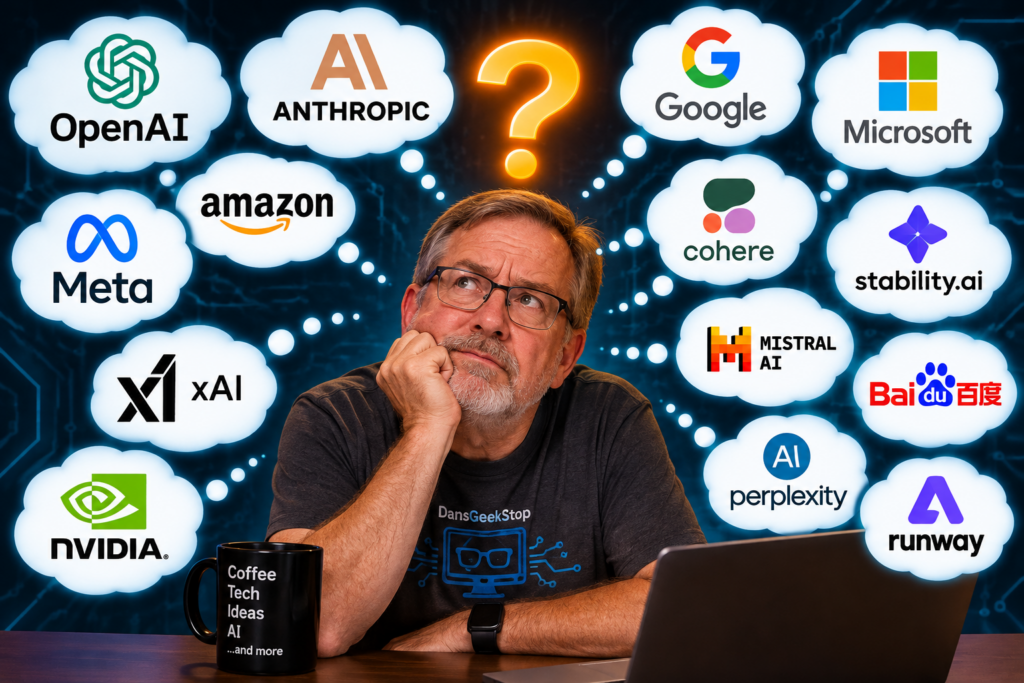
As someone who follows AI pretty closely, I try to keep up with just about every bit of news I come across concerning its development and advancement. But there’s one thing that has started to confuse the daylights out of me: the sheer number of AI companies being mentioned in the news.
It seems like every time I turn around, there’s another company name being tossed into the mix. And frankly, I’ve started wondering just what the hell all these companies actually do.
Do they all develop their own software and code bases? Do they create and train their own AI models? Are some simply developing models that run on existing software? Or are they taking models developed by other companies and building their own products around them?
And here’s another question. Are all these companies basically doing the same thing? If they are, how the hell do they compete with one another? What makes one company’s AI different from another’s?
I understand that AI is a rapidly growing industry, but there are a shitload of companies involved, and keeping track of who’s doing what is becoming a challenge.
So I decided to do a little digging. I want to understand who the major players are, what they’re actually developing, and what sets them apart.
And I figure if I’m getting confused by all these company names, I’m probably not the only one.
So, after talking to Gadget (ChatGPT), my AI client, I’ve learned that the answer is pretty much all of the above.
Some of the major companies develop their own software, code bases, and AI models. Others build their own models using existing AI frameworks and software. Still others take models developed by other companies and build their own applications and services around them.
And then there’s whatever the hell else can possibly be done with AI.
In other words, just because two companies are involved in artificial intelligence doesn’t necessarily mean they’re doing the same thing. And apparently, some of these companies are doing several of these things at once.
With that said, let’s start by looking at the major players in the AI industry. These are companies that develop their own AI software, train their own models, and, in many cases, build the infrastructure needed to support them.
Some of the major players include:
- OpenAI: Developer of ChatGPT and the GPT family of AI models.
- Google (DeepMind): Developer of Gemini and other AI technologies used throughout Google’s products and services.
- Anthropic: Developer of Claude, with a strong emphasis on AI safety, reliability, and business applications.
- Microsoft: Developer of its own Phi and MAI models, while also incorporating models from OpenAI and other companies into its products.
- Meta: Developer of the Llama family of AI models, with a focus on research, open-weight models, and integration into its social media platforms.
- xAI: Developer of Grok, its own family of AI models and related services.
- Amazon: Developer of the Nova family of AI models, while also providing cloud infrastructure and access to models from other companies through AWS.
- NVIDIA: Best known for its AI processors, but also develops AI software, frameworks, and models, including the Nemotron family.
- Mistral AI: A European AI company developing its own language models for general-purpose and business applications.
- Cohere: Develops its own language models, particularly for enterprise applications.
- Baidu: A major Chinese technology company developing the ERNIE family of AI models.
These aren’t the only companies developing their own AI technology, but they’re some of the major names worth understanding. And although they share certain technologies and approaches, they don’t necessarily compete in exactly the same markets.
Well, okay, Gadget. Now I’m more confused than I was before!
Just looking at the list of major players, there’s a shitload of companies involved in AI. And honestly, from what I’ve seen so far, I don’t see all that much difference in their basic functionality.
Sure, some companies offer specialized features or capabilities that others don’t. But when you get right down to it, many of these AI systems appear to do pretty much the same things. They answer questions, generate content, analyze information, write code, and perform a variety of other tasks.
Gadget also wanted me to point out that just because a company develops its own AI models doesn’t necessarily mean it’s building everything from scratch. Some companies use existing software frameworks to train original models, while others modify or fine-tune models that have already been developed.
And that raises even more questions. How much of what these companies are producing is genuinely different? How much is built on technology that already exists? And if so many of them offer similar capabilities, what exactly sets them apart?
At least at this point in my investigation, I’m not seeing a tremendous difference in what many of these companies offer to the average user.
Maybe that will become clearer as we dig a little deeper.
Major AI Companies and What Makes Them Different
The biggest difference between these companies isn’t necessarily what their AI can do. It’s what each company specializes in, who they’re trying to sell to, and how they make money.
Let’s take a look at some of the major players.
- OpenAI: Develops ChatGPT and the GPT family of models. Focuses on general-purpose AI, including writing, research, programming, image generation, and business applications.
- Anthropic: Develops Claude, with particular emphasis on reasoning, computer programming, AI safety, and business applications.
- Google DeepMind: Develops Gemini and other AI technologies. Google has the advantage of integrating AI into its search engine, Android operating system, productivity software, and cloud services. It also develops its own AI processors.
- Microsoft: Integrates AI into Windows, Office, GitHub, and its Azure cloud platform. It develops some of its own AI models while also offering models created by other companies.
- Meta: Develops the Llama family of AI models and integrates artificial intelligence into Facebook, Instagram, WhatsApp, and other products. It also makes some of its models available for others to use and modify.
- xAI: Develops Grok, a general-purpose AI system integrated with X, formerly Twitter. Its services emphasize conversational AI and access to current information.
- Amazon: Develops its own Nova family of AI models while also providing the computing infrastructure that other AI companies use. Through Amazon Web Services, businesses can access AI models developed by several different companies.
- NVIDIA: Best known for developing the processors that power much of the AI industry. It also develops AI software, development tools, and its own AI models. Unlike many of the other companies, much of its business involves supplying the technology that makes AI possible.
- Mistral AI: A European company developing language models, including models that businesses can deploy and customize themselves. It emphasizes flexible deployment and open-weight options.
- Cohere: Concentrates primarily on business applications. Its models are designed for tasks such as analyzing company documents, retrieving information, and working with private business data.
- Baidu: A major Chinese technology company developing the ERNIE family of AI models. Its AI development is closely connected to its search engine, cloud computing services, and the Chinese technology market.
So Why Do They All Seem So Similar?
Because, from the average user’s perspective, many of them really do offer similar capabilities.
Most general-purpose AI systems can answer questions, summarize documents, write computer code, analyze information, generate content, and carry on conversations.
But the differences become more apparent when we look at what happens behind the scenes.
For example, Google can develop its own processors, train AI models, operate the data centers that support them, and distribute its AI through products that millions of people already use.
Anthropic concentrates primarily on developing AI models and services.
NVIDIA, on the other hand, makes much of its money supplying the processors and software infrastructure that other AI companies depend on.
And Microsoft develops some of its own AI models while also incorporating models developed by competing companies into its products.
What Are They Actually Competing Over?
It’s not simply a contest to see which chatbot gives the smartest answer.
They’re competing in several different areas.
- Performance: Which AI models produce the most accurate and useful results?
- Cost: Which companies can develop and operate their AI systems more efficiently?
- Specialization: Which models perform better at programming, scientific research, business applications, or other specialized tasks?
- Infrastructure: Who controls the processors, data centers, and cloud computing services needed to operate AI?
- Customers: Which companies can attract businesses and consumers to their products?
- Control: Can customers operate and customize AI models themselves, or must they depend on the company providing the service?
And here’s something that makes the industry even more interesting.
These companies can be competitors and business partners at the same time.
For example, Amazon develops its own AI models while also providing access to models developed by competing companies.
So What Does All This Tell Us?
At least from what I’ve seen so far, my original observation appears to be reasonably accurate.
For the average person using AI to research a subject, write an article, answer questions, or generate computer code, many of these companies offer remarkably similar functionality.
The biggest differences often involve how the technology is developed, how it’s delivered, what it costs, and which customers the company is trying to attract.
That doesn’t mean the underlying AI models are identical. Their designs, training methods, capabilities, and limitations can be substantially different.
There’s also an important distinction between developing a new AI model using existing software frameworks and modifying an AI model that another company has already cokreated. Using existing development tools doesn’t necessarily mean a company isn’t creating an original model.
But it does help explain why someone following AI news might wonder why so many companies appear to be selling variations of the same thing.
And apparently, the AI industry is a whole lot more complicated than simply developing a chatbot and putting a company name on it.
Okay, I’ll be honest here and state right up front that the summary breaking down the differences between these companies was written by Gadget (ChatGPT).
And I’ll be equally honest about something else. I would not have been able to provide that comprehensive a breakdown on my own. It just wouldn’t have happened.
Normally, I don’t let Gadget write that much of my articles. I prefer to develop my own thoughts, arguments, and opinions, using AI to help with research, fact-checking, and cleaning up my writing.
But in this particular case, I felt that what Gadget provided was a better explanation than I could have written myself. So I decided to use it.
After all, isn’t that part of what AI is supposed to be about? Using a tool to accomplish something more effectively, while still maintaining control over the final product?
Sigh. Let’s see what this dumbass human actually got out of all that information. And I’ll try to summarize it in human terms without writing another book.
Yes, from the average user’s perspective, many of these AI companies appear to provide basically the same thing. But as an old-time programmer with over 40 years of experience, I know one thing for a fact. Not all code is created equal. Two programs can accomplish exactly the same task, but one can be far more efficient, accurate, and reliable than the other. So there’s one important difference right there.
Then look at a company like Google. Think about the enormous amount of information it has accumulated through its dominant search engine and other services. That gives Google a potentially significant advantage when it comes to developing AI and providing accurate, up-to-date information, assuming that data is actually available to its AI systems.
Then we have companies developing their own processors, servers, and supporting infrastructure. NVIDIA, Google, Amazon, and Microsoft come to mind. By developing hardware and infrastructure around their particular needs, these companies can potentially improve performance, reduce costs, and increase efficiency.
And finally, we have the specialized capabilities that different companies offer. Some concentrate on programming, others on business applications, scientific research, image generation, or other specific areas.
So, while many AI systems might appear to do the same things on the surface, the real differences may be in how efficiently they do them, the information they have access to, the infrastructure supporting them, and the specialized capabilities they provide.
At least that’s what this dumbass human managed to get out of all that information.
And while we’re at it, let me point out what I consider one of the royal pains of using AI. Its answers can turn into a bloody book!
I ask what I think is a fairly simple question, and suddenly I’m staring at enough information to fill a chapter. Personally, my eyes start to glaze over when I see explanations that long.
Now, sometimes all that detail is necessary, as it was in this case. But that doesn’t mean I particularly enjoy wading through it.
So hopefully, I managed to take that mountain of information and summarize the important points in plain English, using as few words as necessary.
At least that’s what I was trying to accomplish. And if I missed something important, well, that’s what the comment section is for.
Final Thoughts
Okay, I’m going to close this out with a few final thoughts. This has turned into a much longer article than I normally like to write. Speaking of books!
We’re still in the early stages of AI development. It might not seem that way with all the advancements we’re seeing, but AI, at least in its modern form, is still a relatively young technology.
What I see happening in the future, whether near or far, is consolidation within the AI industry. I think we’ll eventually see fewer major companies dominating the market.
We’re already seeing benchmarks and comparisons showing how different AI systems perform against one another. And when it comes to general-purpose AI, I think we’re going to see a serious battle between OpenAI and Google.
As much as I like ChatGPT, I think Google is going to give OpenAI a run for its money, for a couple of reasons.
First, Google has a long history of developing and operating its own servers and data centers to support its search engine and other services. It also develops its own AI processors, giving it considerable control over the infrastructure supporting its technology.
Second, Google has access to an enormous amount of information through its search engine and other services. That doesn’t automatically make its AI more accurate, but it certainly gives Google some potentially significant advantages.
As for NVIDIA, I think it will remain one of the dominant companies supplying AI processors and supporting technology. That could change if one of the companies developing its own chips makes a major breakthrough, but I don’t see NVIDIA disappearing from the picture anytime soon.
I think something similar will eventually happen with specialized AI systems. Some companies will emerge as leaders in particular fields, while others may merge, get acquired, or simply fall behind. I don’t know enough about those specialized markets to predict which companies will come out on top.
And the companies concentrating primarily on developing AI models? I think many of them will follow a similar path, competing over performance, efficiency, and specialized capabilities.
Of course, these are just my predictions. AI is advancing so quickly that what seems likely today could look completely different a few years from now.
But I do believe that, eventually, we’ll see fewer big dogs dominating the industry.
So, after all this digging, have I answered my original question about what makes these AI companies different?
Well, I guess they are different. But damn, in a lot of ways, they’re very much the same!