
Let me start off this post by apologizing. I forgot my glasses today, and even though I am not blind, writing and editing this is a chore. But even with it being a chore, I enjoy writing these posts.
I tell you this because I am sure there are things I missed during my review and editing. So, if you notice this being one of my worse posts because of repetition, misspellings, or sentences running into each other, please forgive me.
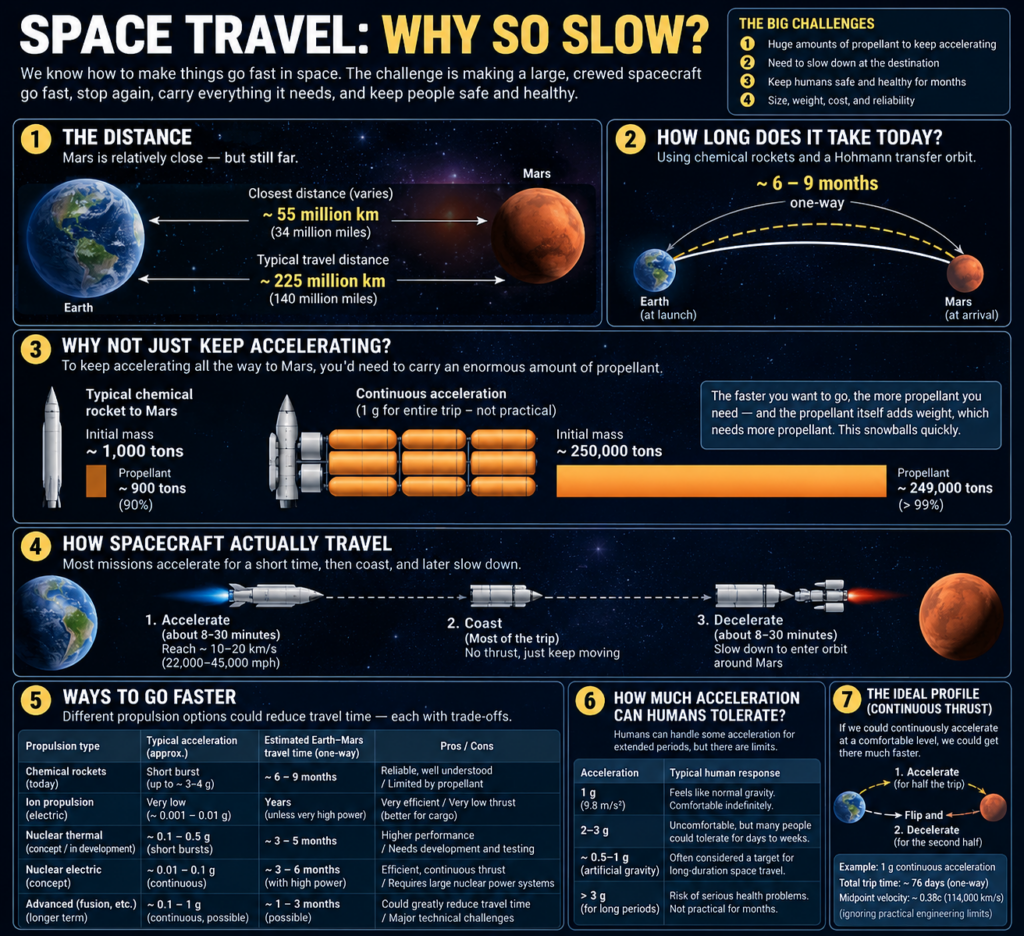
You might ask, what do you mean, why so slow? Don’t we travel at like 17,000 mph or faster? Well, when you think about the distances we travel in space, that is slow.
So, to my question. Humans have now spent since the 1940s developing one form of space travel or another. Be it the German rockets or our modern-day rockets, we are still launching ourselves into space and traveling through it in pretty much the same way.
So, to how we currently launch and travel in space. Basically, we sit on top of a multi-stage Roman candle loaded with fuel that launches either humans or cargo into space.
When you look at those rockets, they are huge suckers. But the problem is that much of the rocket’s size is there to hold the fuel needed to actually get us into space. Once that fuel is burned and the stages are discarded, what is left is pretty much an empty tin can carrying the spacecraft or payload.
As we began launching larger payloads, think of something like the Hubble Space Telescope, the rockets had to get larger. They needed more fuel to lift the additional weight, while also having enough room and lifting capacity for the cargo itself.
You have seen the videos, from the Gemini days to the current day. We drop off the bottom of that huge rocket, which did little more than contain the majority of the fuel needed to get us into space. What is left is the cargo or the human capsule itself.
If we are trying to put something into orbit around Earth, this is fine. We have accomplished what we needed to do, for the most part.
But what if we want to go to another worldly body? The Moon, Mars, and beyond? Most of that fuel is gone. So, how do we get there when we are pretty much out of fuel?
Currently, at this point, we have used liquid fuel to get ourselves this far. Thus, the size of the rockets that we launch. But this type of propulsion restricts us in so many ways when it comes to reaching farther worlds.
Once we are in space, we can’t simply keep those enormous engines running. We don’t have enough fuel. Instead, we use the fuel we have left to put the spacecraft on the trajectory we want and then spend much of the journey coasting. In some missions, we can also use the gravity of another world to slingshot the spacecraft, changing its speed or direction without burning enormous amounts of additional fuel.
What fuel we do have is used for course corrections, changing our trajectory, and eventually slowing down or entering orbit once we reach our destination.
So, our problem in a nutshell when it comes to faster space travel is that we use a huge-ass bottle rocket to get us from point A to point B.
Why aren’t we looking at other means of propulsion? I know we have looked at using nuclear reactors, but there are restrictions and concerns surrounding the use of nuclear power in space. Some of those are safety concerns, and they are legitimate concerns.
So, what else can we do?
Do we continue to launch from Earth using the same methods we use today, and then look to other sources of propulsion for traveling through space? Could we use chemical rockets to get ourselves into orbit, but then switch to something completely different, such as nuclear propulsion, for the much longer journey beyond Earth?
Will nuclear propulsion actually give us enough of a boost in speed that we can cut down our current travel times to nearby worlds? Could that be a short-term solution while we develop other means of propulsion?
Or should we, at this stage, start looking beyond short-term solutions and try to come up with completely different ways of traveling through space? Is our current approach of concentrating on bringing down the cost of launches the best course, or should we be putting more effort into what happens after we get into space?
Before we start talking about traveling faster, we also have to consider the humans sitting inside the spacecraft.
Speed itself isn’t necessarily the problem. Once we reach a certain speed and stop accelerating, our bodies really don’t care how fast we are traveling. The problem is getting to that speed and eventually slowing down again.
Whether we are inside Earth’s atmosphere or traveling through empty space, our bodies still feel acceleration and braking. Humans can tolerate fairly high forces for short periods of time, as astronauts already do during launch. But if we want to continuously accelerate for long periods of time, that acceleration has to remain within limits that the human body can tolerate. The same problem applies when it comes time to slow the spacecraft back down.
Okay, the above explanation came from Gadget, my ChatGPT assistant. I don’t buy it, but not for the reasons you might think.
That explanation talks about continuing to accelerate. But would we actually constantly be accelerating? No, I highly doubt it, at least in our near future.
What I think would occur is that we would accelerate to a specific velocity and then coast at that speed until we reached the point where we needed to start braking.
So, what could the human body handle as far as acceleration? How quickly could we accelerate to a much higher velocity without harming the people onboard? How long would that initial acceleration take?
Back to you, Gadget!
You are actually separating two things that are easy to mix together: acceleration and velocity.
There really isn’t a maximum velocity that the human body can tolerate. Once the engines stop accelerating the spacecraft, your body doesn’t care whether you are traveling at 20,000 mph, 200,000 mph, or even faster. As long as your velocity remains constant, you don’t feel that speed.
The important question is how quickly we can get to that velocity.
For example, if a spacecraft could accelerate at 1 g, roughly the acceleration we experience from gravity while standing on Earth, after one hour it would be traveling about 22,000 mph faster than when it started. Maintain that acceleration for ten hours and the increase would be around 220,000 mph.
Then we could shut down the propulsion system and coast at that speed for much of the journey. Eventually, however, we have the same problem in reverse. We have to slow down. That braking is also acceleration, just in the opposite direction, and the human body has to tolerate it.
So your basic idea works: accelerate at a rate humans can tolerate, reach a much higher velocity, coast for most of the journey, and then begin slowing down before reaching the destination.
The much bigger problem is whether we can build a propulsion system capable of doing it without requiring an absurd amount of fuel or energy.
Sigh. I haven’t even gotten to any of the other forms of propulsion yet, and I am already down a rabbit hole. And so far, this rabbit hole is pretty much restricted to our current goals for human space travel.
The Moon currently takes us about three days to reach. Mars takes us months, generally somewhere around seven to ten months depending on the mission and the positions of Earth and Mars.
So, let’s take on the next question. What kind of speeds would we actually need to reach these worlds within what I would consider a reasonable amount of time? Could we get to the Moon in hours instead of days? Could we get to Mars in days or weeks instead of months?
Just how fast would we have to travel?
And actually, I think this should be our priority right now. The Moon and Mars can become our testing and proving grounds for developing faster methods of space travel.
At this point, we are only talking about exploring our own solar system. We don’t need to develop something capable of reaching another star. Anything that extreme would be overkill for what we are currently trying to accomplish.
The Moon? It takes us about three days now. How about we make it in one day?
Mars? Could we reach it in three days? Six days?
If those are our goals, what kind of speeds would we have to reach? More importantly, how quickly would we have to accelerate to those speeds, and when would we have to start braking so that we didn’t shoot right past our destination?
As previously stated, when it comes to non-human cargo, this isn’t a health issue. We can accelerate a probe or other cargo as quickly as the equipment itself can withstand.
But human space travel is a different story. If we are talking about accelerating for hours or even days at a time, and then doing the same thing again while braking, can the human body actually handle it?
Let’s start with the Moon.
Using our simplified one-day trip, we would accelerate for about 12 hours and then spend another 12 hours slowing down. The acceleration required would be only around 0.02 g.
There is something important to correct in the previous calculations. We don’t necessarily have to spend half of the trip accelerating and the other half slowing down.
What I am really talking about is accelerating hard enough to reach our desired cruising speed, shutting down or greatly reducing propulsion, and then coasting at that velocity for most of the trip. As we approach our destination, we begin braking.
This changes the question considerably.
For the Moon, if our goal is to reduce the trip from about three days to one day, we need to determine what cruising speed would get us there, how quickly the human body could safely accelerate to that speed, and how much time we would need to slow down again.
The same applies to Mars. If we want to reduce a journey that currently takes months to something like three or six days, we don’t necessarily need to accelerate for three days straight. We need to reach a sufficiently high cruising velocity as quickly as the human body and spacecraft can safely tolerate, coast for most of the journey, and then allow enough time to safely slow down.
So the human limitation isn’t really how fast we can travel. It is how quickly we can reach that speed and how quickly we can get rid of that speed when we arrive.
That is the calculation we really need to make. First, is anyone actually thinking about this when designing different propulsion systems for travel within our solar system?
In other words, what we need is a lightweight propulsion system that can accelerate us quickly to a specific speed so that we can reach our destination within a specific amount of time.
We want to reach our balls-to-the-wall speed as quickly as possible, then coast at that speed for the majority of the journey. The only other major consideration would be braking when we approach our destination.
And that brings up another question. Can we brake quickly enough that we don’t have to start slowing down halfway through the journey? If we can accelerate quickly to our cruising speed, then ideally we should also be able to wait until much closer to our destination before beginning to slow down.
So, I think I have laid out our objectives for traveling within our solar system in a reasonable amount of time, while also taking into consideration what the human body can withstand.
I already know that other methods of propulsion are being considered. But can any of them actually address the goals I have laid out? Are we developing propulsion systems that could accelerate us quickly to a high cruising speed, allow us to coast for most of the journey, and then brake quickly enough to safely reach our destination?
Or, if today’s technologies can’t accomplish that, are propulsion systems capable of doing it at least being considered as part of the next phase of space travel?
So, is NASA actually looking at this? The answer is yes.
NASA has studied dozens of high-acceleration propulsion concepts specifically aimed at reducing the amount of time it takes to travel through our solar system, particularly for human missions to Mars.
The problem is that we don’t currently have a propulsion system capable of achieving the extremely short travel times I have been talking about. Nuclear thermal propulsion could potentially shorten a trip to Mars, but we are still talking about months rather than days. More advanced nuclear and electric propulsion systems could eventually improve on that, but many of the more powerful ideas are still studies rather than engines ready to be installed on a spacecraft.
NASA has also run into the same problem we have been discussing here. Getting somewhere faster isn’t simply about reaching a higher speed. We have to accelerate the spacecraft to that speed, provide the enormous amount of energy required to do it, and then get rid of that velocity when we reach our destination.
So, at least someone else is asking the same basic question. Unfortunately, turning a trip to Mars from months into days is still well beyond the propulsion technology we currently have.
Sigh. This is just another one of my posts where I have more questions than I do answers.
I actually wanted to dive deeper into long-distance space travel. But at this point, I think we should concentrate on reaching worlds within our own solar system as quickly and safely as possible.
This seems like a reasonable way to learn and develop new methods of space travel while still accomplishing our shorter-term goals of exploration. Instead of worrying about how we are going to reach another star, let’s first figure out how to get to the worlds in our own backyard without spending months getting there.
In closing, I now know one of the major reasons why space flight is so slow. I just don’t feel it is worth looking beyond this until we solve these simple problems we face right now.
Simple? Hell, they didn’t sound very simple to me.