
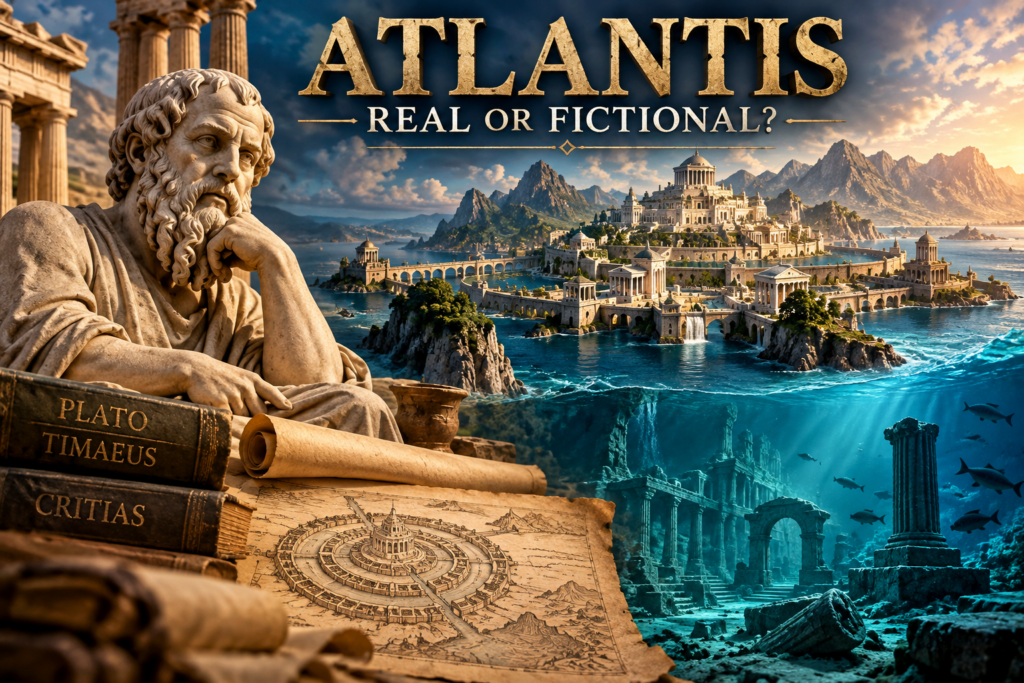
The story that Plato wrote tells of a great and advanced civilization that was devastated and sank into the ocean. Was this a real city that Plato was writing about? Or was it just a great fictional story?
The experts and the scientific community generally say no, Atlantis was fictional. But you know me. I love taking on the experts’ opinions. Just because.
So, let’s run with the idea that Atlantis could have been real. After all, why have so many people spent so much time searching for it in different parts of the world?
So, let’s start with the story itself, as written by Plato.
Plato tells the story of Atlantis in two dialogues, Timaeus and Critias, written around 360 BCE. In the story, Critias says the account ultimately came from Egyptian priests and was later brought to Athens by the Greek statesman Solon.
Atlantis was described as a large and powerful island civilization located beyond the Pillars of Heracles, generally identified with the Strait of Gibraltar. The island was wealthy in natural resources, had fertile farmland, impressive buildings, harbors, canals, and a remarkable capital arranged in concentric rings of land and water.
According to the story, Atlantis had originally been established by the god Poseidon. Its rulers were initially prosperous and virtuous, but over generations they became increasingly greedy and hungry for power. Atlantis eventually attempted to conquer lands around the Mediterranean.
Athens resisted and defeated the Atlantean forces. Afterward, according to Plato, violent earthquakes and floods struck, and Atlantis disappeared beneath the sea in a single day and night of destruction.
One particularly interesting detail is that Plato places the destruction of Atlantis about 9,000 years before Solon’s time. Taken literally, that would put it roughly around 9600 BCE, thousands of years before civilizations capable of building a city like Plato describes are currently known to have existed.
Plato’s Critias ends unfinished, so we never actually get the complete story of Atlantis.
Remember, I wrote a previous article titled “Piri Reis Map and Earth-Crust Displacement” which discusses a map from the 1500s that showed parts of the Earth that had not been previously explored. In that article, I bring up the idea that, through possible major changes to the Earth, previous advanced civilizations could have become buried, with little or no evidence still available today.
So, JUST because nobody can find a record of Atlantis, could it be due to what I discussed in this previous article?
Or maybe all the records have been lost or are being hoarded someplace in a library, never to see the light of day. Who is to say?
But I feel the possibility is there that Atlantis did previously exist.
Besides my previous post about possible advanced societies for which there is no longer any record, due to the natural events of the Earth over thousands, millions, or even billions of years, the story about Atlantis sinking into the sea raises another possibility for why we haven’t found it YET.
The oceans are one area of the Earth that have barely been explored. So, if we can’t say that we know everything about our oceans, how can we make any conclusive decision about whether Atlantis could be down there somewhere?
And what is interesting is that discoveries are being made on the ocean floor of what appear to be previous cities or civilizations. Rock structures have been found with straight lines and formations that resemble roads or buildings.
There is no single explanation for all of these findings. Some may have natural explanations, while others continue to raise questions about what they actually are. I’m not saying that they prove previous cities or civilizations existed. I’m saying they can’t simply be ignored because we don’t yet know what all of them are.
And if we are still finding things on the ocean floor that we can’t completely explain, what else could still be down there?
There are actually several interesting discoveries beneath the oceans that add to this discussion.
One example is Pavlopetri, off the coast of Greece. This is not just a strange rock formation. Archaeologists have identified the remains of an actual submerged settlement, including streets, buildings, graves, and other evidence of human occupation. Whatever caused it to disappear beneath the water, we know that people once lived there.
There have also been discoveries off the coast of the United States. Off Florida, archaeologists have found prehistoric sites in areas that were once dry land. Stone tools and other evidence of human activity have been discovered underwater, showing that people once occupied landscapes that are now beneath the Gulf.
Then there is the Yonaguni Monument near Japan. This one gets much more interesting. It is a massive underwater rock formation containing terraces, straight lines, sharp angles, and formations that resemble steps. Some researchers believe that humans may have constructed or modified parts of it, while other researchers believe that the formations were created naturally through geological processes and erosion. There is still disagreement about exactly what Yonaguni represents.
None of these discoveries proves that Atlantis existed. But they do prove something that is important to my argument. Human settlements and landscapes where people once lived CAN disappear beneath the ocean.
And when we find something like Yonaguni, where there is disagreement over exactly what we are looking at, it raises another question.
What else is still down there that we haven’t found yet?
Do you get my point here? The experts say there is no evidence of Atlantis, but they can’t even agree on what some of the things already discovered beneath the oceans actually are. In some cases, even when there is clear evidence of human occupation, we still don’t know exactly who lived there or what happened to them.
So, how can we conclusively say that Atlantis never existed when we haven’t even explored most of our oceans, and we are still trying to understand some of what we have already found?
Man, I love poking the bear when it comes to the so-called experts. That includes the AI client I use, ChatGPT, otherwise known as Gadget, who keeps trying to reword what I am saying here.
“You can’t say that. There is no evidence.”
Yes, Gadget, I can. Because I flat out say that I see holes in both your argument and the experts’ opinions. I’m not saying Atlantis existed as a proven fact. I’m saying I don’t think we have enough evidence to conclusively say that it didn’t.
So, did Atlantis exist? Haven’t a clue. Don’t really care, to be honest, other than the fact that it is an absolutely fascinating story that, if true, would be historically earth-shattering.
And I love history. I also love seeing the experts proven wrong.
Sorry, I forgot to tell you to put your tin foil hat on at the beginning. I just felt like wandering into the unknown today, and once I got started, I couldn’t stop myself.