
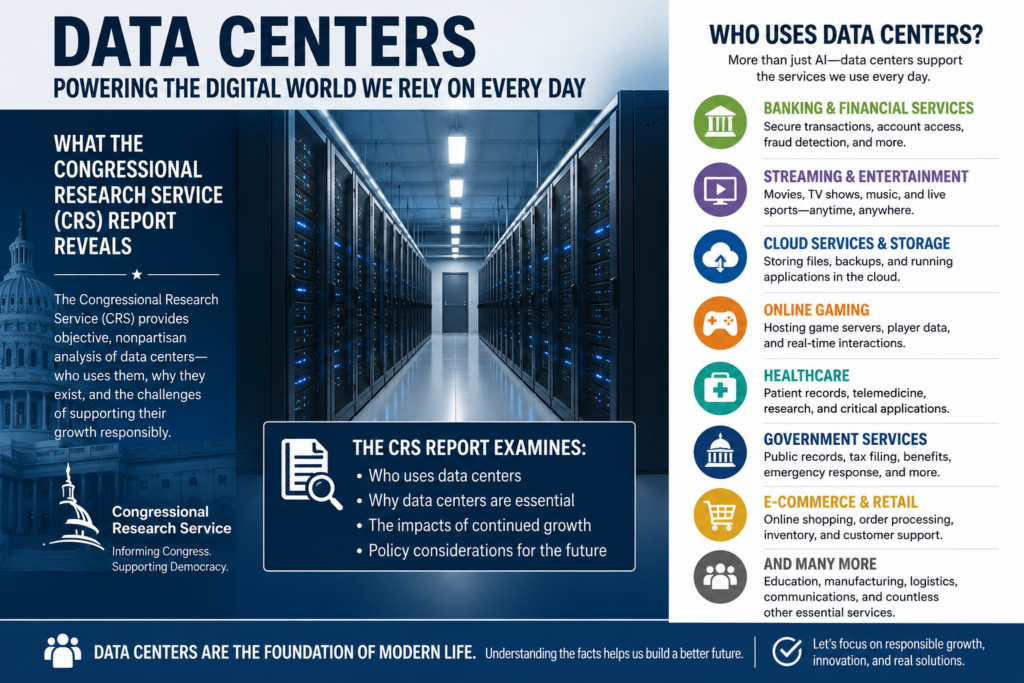
I have written a number of articles and posts about Data Centers and the criticism they have received from the media, government officials, and the public in general. Throughout those articles, I have tried to explain that Data Centers have been around for a very long time. They are not suddenly appearing because of Artificial Intelligence. They have been built, and continue to be built, to support many of the services we already rely on every single day. AI is simply another reason we need Data Centers, not the only reason.
I have also tried to point out that many of the concerns being raised are real and deserve discussion. However, too many of the opinions being formed, and in some cases the decisions being made, are based on only part of the story. Much of the public conversation focuses on headlines, clickbait articles, or the loudest voices online rather than examining the complete picture of what Data Centers actually do and who depends on them.
History suggests there will always be another technology that requires more computing power. Rather than pretending that demand will simply disappear, perhaps the better conversation is how we can responsibly build and operate the Data Centers that modern society increasingly depends upon.
So, before we decide what should or shouldn’t be built, let’s first take an honest look at what is already there.
The Congressional Research Service (CRS) exists for one purpose: to provide Congress with well-researched, objective, and factual analysis on the issues our elected officials face. Their reports are written to inform lawmakers, not to persuade them. In my experience, they are among the most thoroughly researched and unbiased resources available on a wide range of topics.
Unfortunately, objective research doesn’t always translate into objective policy, and lawmakers don’t always follow the recommendations or findings presented to them. That’s simply the reality of politics.
For this article, however, politics doesn’t matter. We’re going to use this report for what it was intended to be: an objective source of information. We’ll use the Congressional Research Service as the foundation for examining who uses Data Centers, why they exist, and what role they play in our increasingly digital world.
With that in mind, let’s take a look at what the Congressional Research Service has to say about modern Data Centers.
Data Centers and Their Energy Consumption: Frequently Asked Questions
There are several important points being made in that single statement.
First, data centers have continued to expand because both public and private organizations have steadily increased their IT requirements over many years. This is not a recent trend, nor is it one driven by a single technology.
Second, the growth of data centers has been fueled by ever-increasing amounts of data and the growing demand for computing resources. Every year we create, store, process, and transmit more information than the year before, requiring additional infrastructure to support it.
Finally, while the report identifies Artificial Intelligence as a significant new driver of demand, it does so within the broader context of the continuing growth of digital services. In other words, AI is contributing to the need for additional data center capacity, but it is not the sole reason data centers continue to expand.
Artificial Intelligence Is Accelerating Growth, Not Creating It
There is no question that Artificial Intelligence is placing new demands on modern Data Centers. Training and deploying AI models requires tremendous computing power, specialized hardware, and significant amounts of electricity. The Congressional Research Service recognizes AI as an important and rapidly growing contributor to future data center expansion.
However, the report does not present AI as the sole reason data centers are being built. Instead, it places AI within the broader context of increasing digital services, growing data volumes, and the expanding computing needs of both public and private organizations.
That distinction is important.
Data Centers were already expanding long before the recent explosion in AI. Businesses were moving to the cloud. Streaming services were adding millions of subscribers. Online shopping continued to grow. Government agencies were digitizing records and services. Healthcare organizations, financial institutions, universities, and countless other industries were all increasing their reliance on digital infrastructure.
Artificial Intelligence is adding to that demand, and in many cases accelerating it, but it is only one piece of a much larger picture. Understanding that bigger picture is essential if we want to have an informed discussion about the future of Data Centers.
The real issue isn’t whether we need data centers. It’s how we manage their continued growth responsibly.
How do we accommodate growing demand while addressing its impacts?
What this report is saying is the same thing that I have been saying all along. Data Centers are not just about Artificial Intelligence. They provide the infrastructure behind countless services that most of us use every day, and in many cases have used for years. Banking, streaming services, cloud storage, online gaming, e-commerce, healthcare, government services, and many other applications all rely on Data Centers. As more people use these services and the amount of data continues to grow, so does the demand for computing power, storage, and the facilities that make it all possible.
You may not like the conclusion this leads to, but it is one we all need to face. If you don’t want Data Centers, then you, as an individual, need to make the choice not to use the services they provide. That means giving up AI, streaming services, cloud storage, online gaming, and many of the digital conveniences that have become part of everyday life. You cannot honestly demand fewer Data Centers while expecting the services they power to continue expanding. It doesn’t work that way.
Once you accept that reality, the conversation changes. Instead of arguing over whether Data Centers should exist, let’s work together to make them better. Let’s invest in cleaner energy, more efficient cooling technologies, smarter designs, and better environmental practices. Data Centers are not going away because our demand for digital services isn’t going away. The real challenge is making sure they are built and operated as responsibly as possible.