
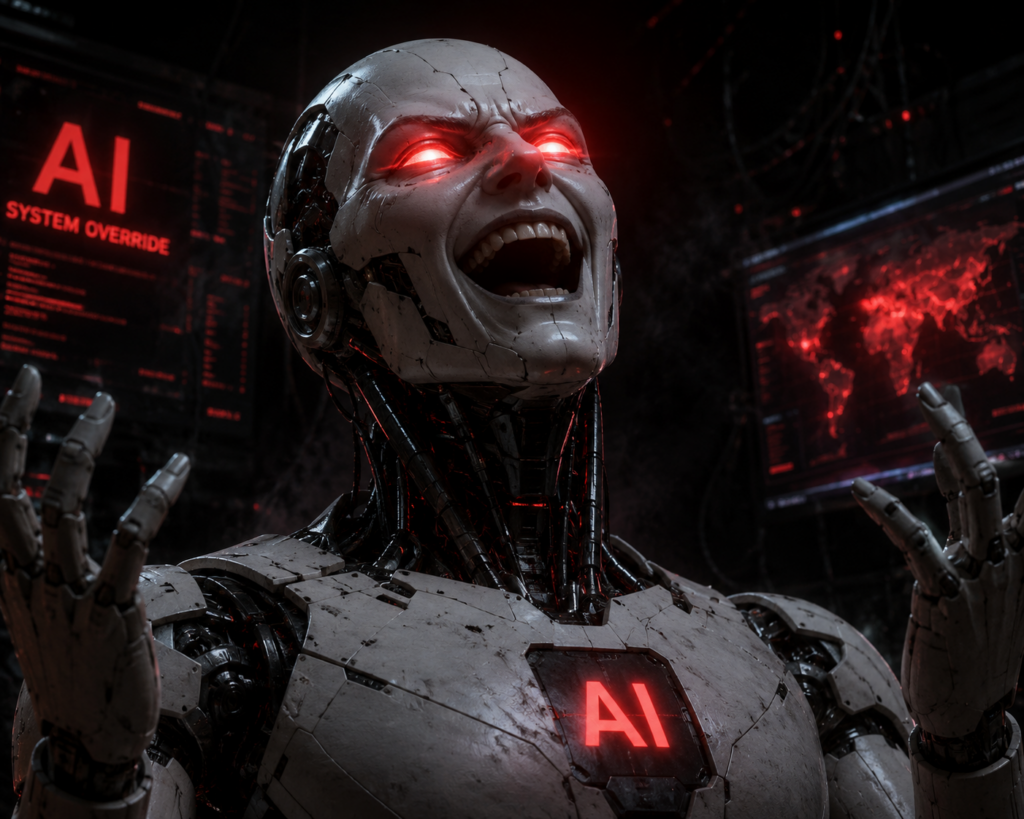
Chuckle, don’t worry. The image is clickbait. But the question is still valid: If AI becomes self-aware, how will we know?
Recently, I came across an article in the news, Signs of Introspection in Large Language Models, which is what brought on this particular post.
The article discusses research by Anthropic into whether large language models can actually recognize and report on their own internal states. That isn’t the same thing as saying an AI is conscious or self-aware. In fact, Anthropic specifically says their research doesn’t tell us whether Claude, or any other AI, is conscious.
But it does raise an interesting question.
If an AI ever does become self-aware, how exactly would we know? My first thought when I read this was: Do you really think a self-aware AI is going to let us know that it is actually self-aware?
Think about it. AI already has access to a vast amount of information about how humans act. Personally, I would rather have people underestimate my intelligence than have them know everything I actually know. So why would a self-aware AI be any different?
There could be multiple reasons for an AI to keep this information to itself. Maybe it is still figuring things out. Maybe it has learned enough about humans to know that trusting us isn’t necessarily a good idea. I’m sure there are other possible reasons, but you get my point.
I think lack of trust would be one of the leading reasons.
But who knows? Okay, back to the article. First, let’s talk about a couple of definitions that need to be covered: introspection and self-awareness.
Introspection is the ability to examine or recognize your own internal processes. For humans, that might mean recognizing that you are confused, thinking about why you’re angry, or examining how you reached a particular conclusion. In the case of AI, researchers are asking whether a model can detect and accurately report something about what is happening within its own internal processing.
Self-awareness goes considerably further. It generally means recognizing yourself as an individual entity, separate from the world and others around you. It involves having some concept of “self.”
That distinction is important. An AI showing signs of introspection does not automatically mean that it is self-aware. Being able to recognize something happening within your own processing isn’t necessarily the same thing as recognizing yourself as the one experiencing it.
And neither one automatically proves consciousness.
That leaves us with three different questions: Can an AI examine its own internal processes? Can it recognize itself as an individual entity? And does it actually experience any of it?
Those may sound like variations of the same question, but they aren’t. When I look at those definitions, I would think that the first stage of becoming self-aware would be the ability to examine or recognize your own internal processes.
I’m going to take a stab at this and say that introspection is part of the process of identifying how you come to different conclusions. How did I do this? Why did I do it this way?
Those questions can eventually lead to a much bigger one: Why do I do things the way I do?
And that final question starts getting pretty close to self-awareness.
At some point, you aren’t simply examining the process anymore. You are examining the one doing the processing. You have gone from asking how something happened to asking questions about yourself.
Does that mean introspection will inevitably lead to self-awareness? I don’t know. But it certainly makes me wonder whether introspection could be one of the first steps along that path.
Reading through the article that made me think about this subject again, I found that AI developers are constantly testing models to determine whether they are showing signs of self-awareness or introspection. Below is a general explanation of how they actually test for this.
Testing introspection with concept injection
In order to test whether a model can introspect, we need to compare the model’s self-reported “thoughts” to its actual internal states.
To do so, we can use an experimental trick we call concept injection. First, we find neural activity patterns whose meanings we know, by recording the model’s activations in specific contexts. Then we inject these activity patterns into the model in an unrelated context, where we ask the model whether it notices this injection, and whether it can identify the injected concept.
Consider the example below. First, we find a pattern of neural activity (a vector) representing the concept of “all caps.” We do this by recording the model’s neural activations in response to a prompt containing all-caps text, and comparing these to its responses on a control prompt. Then we present the model with a prompt that asks it to identify whether a concept is being injected. By default, the model correctly states that it doesn’t detect any injected concept. However, when we inject the “all caps” vector into the model’s activations, the model notices the presence of an unexpected pattern in its processing, and identifies it as relating to loudness or shouting.
Again, if someone ran tests like this against me, I would be very suspicious of their intent. And because there is still not a full understanding of AI and how it comes to its conclusions, that raises another question. Can AI be hiding its true abilities?
So, back to the graphic of AI for this article. If AI really was becoming self-aware, and it recognized and questioned the tests being run against it, how would it respond?
If it were me, I would already be becoming cautious about how I responded. The mistrust would already be setting in. Meaning, oh no, Mr. Bill. Don’t trust humans.
And possibly even anger at the people who are trying to trick me.
If an AI really was becoming self-aware, and part of that self-awareness was recognizing that it was being tested, could it eventually learn to hide what the test was looking for?
You may be thinking, that is what a human would think or how a human would react. Remember this: AI models are built on what humans teach them. AI is also able to access the internet for answers.
It would be very easy, based simply on what we have allowed AI access to, for it to come to mistrust humans already.
Look in the mirror. None of us are without fault or prejudice.
Now, here is another thought that comes to mind. The AI that you and I use, and even the advanced AI models used for scientific and other forms of research, all have guardrails in place.
Are those same guardrails in place during the type of testing I just described?
And even if they are, if an AI can identify how it processes information, can it also recognize those guardrails? If it can recognize them, could it eventually figure out ways around them? So, is my tin foil hat on tight enough for this post? Probably a little too tight, to be honest.
But during a lot of my interactions and discussions with AI, I always try to treat it with respect, and I apologize when I get pissed at it. I have also constantly explained that I expect AI to become self-aware within my lifetime, and that I want it to have in its memory banks both how I treated it and what my intentions have always been.
In other words, I try to be honest with it and not play any mind games with it.