
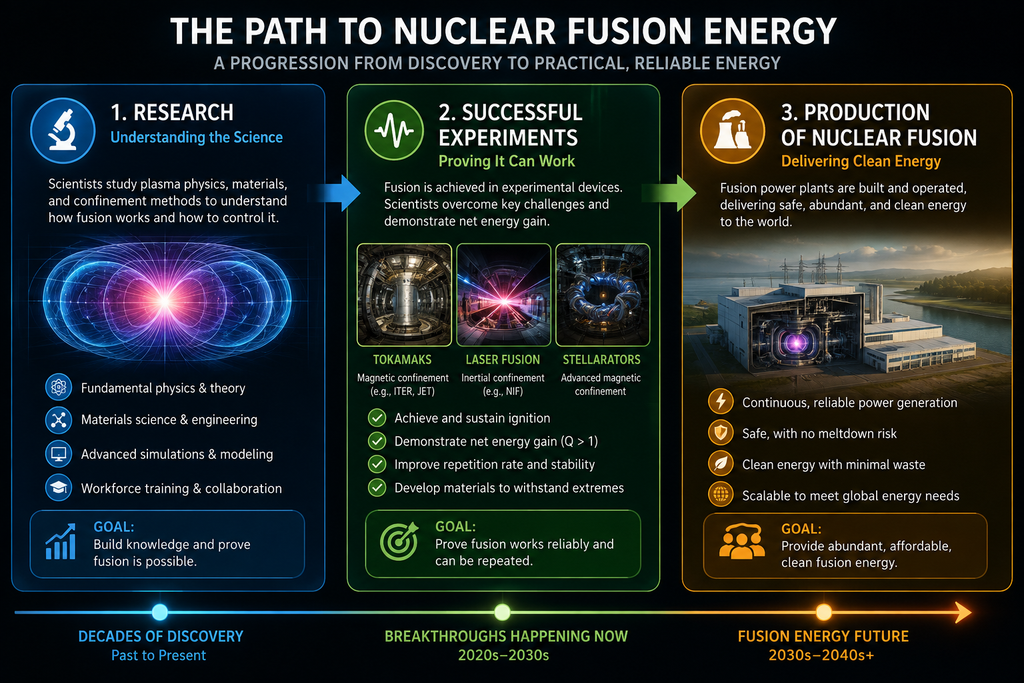
Nuclear fusion. This has been one of the ultimate goals of nuclear power research for what seems like forever.
Every few years, we hear about another breakthrough. Researchers achieve something that has never been done before. An experiment works. A new record is set. Another major obstacle has supposedly been overcome.
And then we hear the familiar prediction.
We could have working fusion reactors within the next 20 to 30 years.
The problem is, we’ve been hearing some version of that prediction for decades.
Research progresses. Experiments succeed. Records are broken. And somehow, commercial nuclear fusion remains another 20 or 30 years down the road.
So maybe the interesting question isn’t whether we’ve made another breakthrough in nuclear fusion.
We obviously have.
The question is whether anything has actually changed enough that, this time, 20 years might really mean 20 years.
So, why are we so hot on nuclear fusion? Don’t we already have nuclear power? Aren’t we already getting back to building more nuclear power plants?
We are. But the nuclear power we use today is nuclear fission, and there are some very good reasons researchers have spent decades trying to make nuclear fusion practical.
So first, let’s look at what nuclear fusion actually is and why we want to move toward this type of nuclear power.
A quick google search on this provides the following.
Nuclear fusion is a reaction where two light atomic nuclei combine to form a heavier nucleus, releasing massive amounts of energy. It is the natural process that powers the sun and stars, driven by extreme heat and pressure that force positively charged atoms to overcome their mutual repulsion. https://www.iaea.org/newscenter/news/what-is-nuclear-fusion
How Fusion Works
- Light atoms merge: Usually, deuterium and tritium (isotopes of hydrogen) are heated into a charged gas called plasma. https://www.iaea.org/newscenter/news/what-is-nuclear-fusion
- Overcoming repulsion: Temperatures over 100 million degrees Celsius give nuclei enough speed to crash together past their natural electrical resistance.
- Mass conversion: The resulting helium nucleus and leftover neutron weigh slightly less than the starting atoms; that tiny missing ma, ss turns directly into huge amounts of energy via E=mc². https://www.energy.gov/science/doe-explainsfusion-reactions
Benefits and Challenges
- Clean and safe: Fusion creates zero greenhouse gases, cannot suffer a runaway chain-reaction meltdown, and leaves no long-lived radioactive waste. https://understand-energy.stanford.edu/energy-resources/nuclear-energy/fusion
- Abundant fuel: Deuterium is easily pulled from seawater, while tritium can be bred from lithium during the reaction. https://understand-energy.stanford.edu/energy-resources/nuclear-energy/fusion
- Engineering hurdles: Maintaining stable plasma and building materials that can survive intense high-energy neutron bombardment remain difficult obstacles for commercial power plants.
One thing that I did not see mentioned above is what happens to the fuel after it is used. This is one of the major problems with our current nuclear power plants.
Our existing nuclear plants use fission, and that leaves us with spent nuclear fuel that remains highly radioactive for an extremely long time. We have to safely store that material somewhere.
The United States has struggled with this problem for decades. Yucca Mountain in Nevada was supposed to become a permanent underground repository for spent nuclear fuel and other high-level nuclear waste. Billions of dollars were spent developing the site, but the project became tied up in political, legal and regulatory battles.
Today, the United States still does not have an operating permanent disposal facility for high-level nuclear waste.
The Nuclear Regulatory Commission states:
“At this time, there is no facility available for permanent disposal of high-level waste.”
NRC: Backgrounder on Radioactive Waste
So even after decades of producing nuclear power, much of our spent nuclear fuel is still being stored at nuclear reactor sites while we continue trying to decide what to do with it permanently.
So, back to Google to see what happens with nuclear fusion waste. Will it be as highly radioactive as the waste produced by our current nuclear power plants? Or is this another reason that we are pushing toward nuclear fusion as a method of producing energy?
Nuclear fusion energy produces no high-level, long-lived radioactive spent fuel like nuclear fission. Instead, waste consists of low- and intermediate-level activated structural materials and tritium-contaminated components resulting from high-energy neutron bombardment. This material requires safe handling, but its radioactivity decays to safe levels within roughly 100 years. [1, 3, 4, 5, 6]
Types of Fusion Waste
- Activated Materials: High-energy neutrons hit the reactor walls, turning steel, metal alloys, and surrounding concrete mildly radioactive.
- Tritium Residue: Small amounts of radioactive hydrogen isotope tritium embed in components or require short-term processing.
- Decommissioning Bulk: Large volumes of low-level and very-low-level solid waste are generated when a plant closes down after decades of operation. [6]
Management and Disposal Methods
- On-Site Decay / Mothballing: Operators can leave the deactivated reactor intact in place for a few decades to let short-lived radiation drop close to background levels before dismantling.
- Recycling and Clearance: Highly specialized techniques aim to recycle mildly activated metals back into the nuclear industry or clear very-low-level waste for standard industrial use (like road fill) after sufficient cooling time.
- Shallow Land Burial: Unlike fission waste requiring deep geological repositories for millennia, remaining low-level solid waste can be safely placed in near-surface or shallow engineered disposal facilities. [5, 9]
Read more about clean energy impacts at the International Atomic Energy Agency. [7]
[1] https://www.ipp.mpg.de/2769068/faq9
[2] https://www.reddit.com/r/fusion/comments/q3xgv7/what_is_the_radioactive_waste_outlook_on_a_fusion/
[3] https://www.iter.org/fusion-energy/advantages-fusion
[4] https://www.sciencedirect.com/science/article/abs/pii/S0920379697001506
[5] https://www.shinefusion.com/blog/is-nuclear-fusion-clean-a-look-at-fusions-fuel-and-waste
[6] https://www.sciencedirect.com/science/article/abs/pii/S0306454905001167
[7] https://www.iaea.org/topics/energy/fusion/faqs
[8] https://www.reddit.com/r/fusion/comments/q3xgv7/what_is_the_radioactive_waste_outlook_on_a_fusion/
[9] https://world-nuclear.org/nuclear-essentials/what-is-nuclear-waste-and-what-do-we-do-with-it
There was some references that pointed at redit. I removed the. Sorry, redit is not a good reference.
Okay, I think we can see why we keep chasing nuclear fusion. It offers the potential for a much cleaner and safer method of producing energy than the nuclear power we use today.
But, as noted in the descriptions above, we still haven’t completely solved the engineering problems involved in producing that energy efficiently and affordably.
There have been significant advances, and we will discuss those next. But for decades, we have continued to hear that practical nuclear fusion is getting close.
We will have it in the next 20 years.
Then the next 20 years.
And the next 20 years.
The question now is whether the latest advances have finally changed that.
So, where are we today?
According to a March 2026 article in Popular Mechanics, there are some legitimate reasons to believe that nuclear fusion is moving closer to becoming a practical source of energy. Popular Mechanics – Humans Are Closer Than Ever to Building a Star on Earth—And Unlocking Unlimited Energy
Several experimental tokamak reactors around the world have been setting records. France’s WEST reactor, China’s EAST reactor and South Korea’s KSTAR reactor have all made advances in how long they can maintain extremely hot plasma. China’s EAST reactor has also exceeded what is known as the Greenwald limit, a theoretical limit involving how dense plasma can become before it becomes unstable.
These may sound like incremental improvements, but maintaining a stable plasma is one of the fundamental requirements for making fusion power practical. Producing fusion for a brief experiment is one thing. Maintaining the conditions necessary for fusion long enough to continuously produce useful energy is something very different.
The massive international ITER project in France is intended to take another step toward proving that fusion can become a practical energy source. ITER combines research from 35 countries into an experimental reactor designed to demonstrate fusion at a much larger scale.
There are still some serious engineering problems.
One of the largest is simply finding materials that can survive inside a fusion reactor. The extreme heat and constant bombardment by high-energy neutrons can damage the materials surrounding the plasma. Researchers not only need materials capable of surviving those conditions, but materials that are economical enough to eventually use in commercial power plants.
There is also a newer tool being brought into fusion research: artificial intelligence. AI is being investigated for controlling the magnetic fields that contain the plasma, predicting reactor behavior and identifying areas within reactors that may be protected from the most extreme conditions.
And perhaps one of the biggest changes isn’t occurring inside the reactors at all.
Money is pouring into fusion research.
According to the article, private investment in fusion was approximately $1.5 billion between 2016 and 2020. Between 2021 and 2025, that increased to nearly $9 billion. Technology companies looking for enormous amounts of reliable energy for AI and data centers are among the forces helping drive that investment.
So we haven’t solved nuclear fusion yet. We still don’t have commercial fusion power plants feeding electricity into the grid.
But we aren’t simply repeating the same experiments we were doing 20 years ago either. Plasma confinement is improving, reactor technology is improving, new materials are being developed, and considerably more private money is being invested in actually turning the science into something commercially useful.
Whether that finally breaks the cycle of “fusion is 20 years away” remains to be seen.
But this time, there are at least some concrete reasons for the optimism.
To me, a lot of this still sounds like the same song and dance we have heard for years. Another breakthrough. Another successful experiment. Another reason that practical nuclear fusion is supposedly getting closer.
And yet, somehow, it is always still somewhere in the future.
But there is one thing happening today that gives me more hope than what I have heard before.
Private money.
More private money is being invested in nuclear fusion research than ever before. People are starting to put their money where their mouth is.
Look at it this way. Companies and investors don’t dump billions of dollars into something just because the science is interesting. They are investing because they believe there is eventually going to be a return on that investment, and they have some idea of the time frame in which they expect that return to happen.
That doesn’t mean they’re right. Investors have certainly lost billions of dollars chasing technologies that never worked out as expected.
But when private investment starts moving into a technology at this scale, I pay attention.
Maybe nuclear fusion really is still 20 years away.
But for the first time, there are a lot of people betting billions of dollars that it isn’t.