
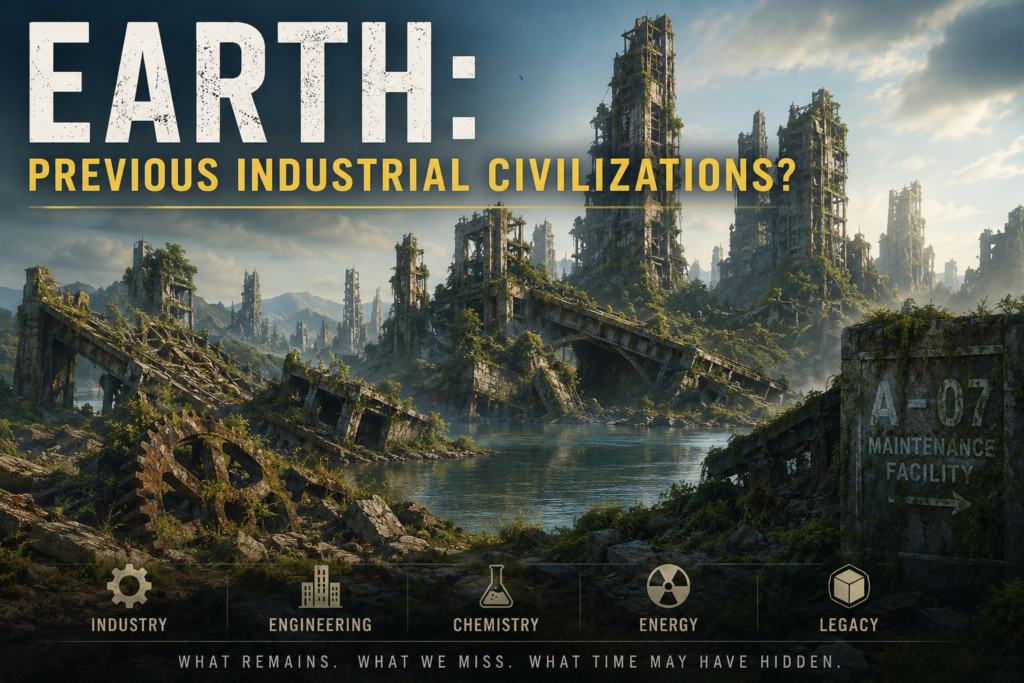
Interesting concept, eh? I am an avid reader, and one of the fictional book series I read was about this not being the first industrial civilization on Earth. I actually got into a discussion about this on an astronomy site I was part of at the time. It was pretty much stated that we would have found evidence of these previous civilizations already.
But would we? That was my point.
The Earth is about 4.54 billion years old and has gone through many changes during that period of time. This civilization that you and I are experiencing now is what? How many thousands of years old? Not even a drop in the bucket when you think about it.
I pretty much forgot about the whole thing until I found a white paper looking at this very idea. Dry as dirt, trust me. But the question of whether we would actually be able to detect a previous industrial civilization was examined from a scientific perspective in The Silurian Hypothesis: Would it be possible to detect an industrial civilization in the geological record?
When I previously mentioned that this paper is dry as dirt, it is. But that is normally what you get from a scientific white paper.
So, being the dedicated blogger I am, I cheated and had ChatGPT summarize the paper.
So, what would we expect to find from a previous industrial civilization? It’s pretty straightforward when you think about it.
- Structures and artifacts: buildings, roads, machines, mines, tools. These are the obvious things we’d expect to find, but over tens or hundreds of millions of years they’re actually among the least reliable.
- Metals and unusual concentrations of elements: industrial activity concentrates and redistributes metals in ways geology might preserve.
- Plastics and synthetic chemicals: potentially distinctive because some compounds don’t occur naturally.
- Radioactive isotopes: nuclear technology could leave unusual isotope signatures.
- Chemical/isotopic changes: this is actually one of the big ones in the Silurian paper. Industrial activity can alter carbon, nitrogen, oxygen and other isotope patterns that become incorporated into sediments.
- Fossils and biological changes: sudden extinctions, species migrations, domesticated species spreading widely, or other abrupt ecological changes could leave geological fingerprints.
These were pretty much the arguments against previous industrial civilizations that I got on the astronomy forum.
BUT, again.
The Earth is over 4 billion years old. It has changed a lot during that period of time. And honestly, who’s to say that previous industrial civilizations were anything like the one we’re living in now?
Did they develop and invent the same things?
Did they use the same materials?
How long ago did this occur? Continents have formed, broken apart, collided, and changed dramatically over those 4 billion years. The Earth has been bombarded by asteroids and has experienced other catastrophic events. Erosion, plate tectonics, volcanic activity, glaciers, oceans, and countless other natural processes have continually changed the surface of the planet.
All of these natural processes could bury, crush, alter, or completely destroy evidence that may once have been present.
Metals corrode and deteriorate. Structures collapse and are eventually buried or eroded away. Even plastics aren’t necessarily the smoking gun we might think they are. We already know how to make plant-based plastics that can biodegrade.
So, who’s to say that previous civilizations weren’t simply smarter about some of this from the beginning than we are now?
Maybe they didn’t leave behind the same garbage we do.
So, do we have all the information about the Earth and what it was like before? The answer is actually no.
What is noted in this scientific paper is that the geological record is very incomplete. Once you get beyond the last few million years, evidence from ancient land surfaces becomes sparse. Even more interesting, because oceanic crust is continually recycled, the surviving ocean-sediment record only goes back roughly 170 million years. The authors conclude that for a hypothetical civilization older than about 4 million years, the chances of finding direct artifacts or fossils from it would be small.
Ummm, didn’t I say that in the beginning?
The Earth is more than 4 billion years old. And Mother Earth is like most women. She changes as she gets older. She discards what she no longer needs.
In other words, when you start going back millions of years, much of the record has been erased, recycled, buried, crushed, or altered beyond recognition.
But there are some interesting things that have been identified in the geological record. Scientists have natural explanations for these events, so I’m not claiming they were caused by some ancient civilization. What makes them interesting is that some of their geological fingerprints resemble the kinds of changes an industrial civilization might leave behind.
- Paleocene-Eocene Thermal Maximum (PETM), ~56 million years ago: Abrupt carbon-isotope changes, rapid carbon input, major warming, and ecological changes. The carbon appears to have entered the system very rapidly in geological terms, perhaps in less than 5,000 years.
- Other Eocene hyperthermal events also produced significant changes in climate and the carbon cycle.
- Cretaceous and Jurassic Ocean Anoxic Events: Periods involving major disturbances to the carbon cycle, warming, and low-oxygen oceans.
- Older Paleozoic and Mesozoic events exist that are less well characterized.
And there is one sentence in the paper that really caught my attention:
“There may be more such events in the record”
Look, if you have read any of my posts, you know that I do wear a tin foil hat. Sometimes it is on tighter than other times. In this case, I don’t think I have it on all that tight.
There are simply too many questions.
Eh, the given explanation is just too pat for me.
It again falls back to what I have said about other things. Can’t travel faster than light? That statement is based on our current understanding of physics and mathematics. Who is to say that we won’t discover something in the future that changes what we think is possible?
With this, I think the scientific community may be ignoring the bull in the china closet.
The Earth has changed drastically over millions of years. Continents have moved, oceans have appeared and disappeared, entire species have come and gone, and the surface of the planet has been repeatedly reshaped. And the Earth IS more than 4 billion years old.
Yet we are talking about our ability to find direct evidence of something that might have existed millions, tens of millions, or even hundreds of millions of years ago, while at the same time acknowledging that huge portions of that geological record no longer exist.
I am not saying that an industrial civilization existed before us. I have no evidence to make that claim.
What I am saying is that I think we are way too quick to say that one didn’t.
Maybe there was nothing here. Maybe humans really are the first species on Earth to develop an industrial civilization.
But when the evidence needed to answer the question may have been erased millions of years ago, I don’t think we should confuse “we haven’t found it” with “it never happened.”
I just don’t think we should ignore the possibility. We should keep looking.
There are still too many questions.
Pingback: Piri Reis map and Earth-crust displacement - Dans Geek Stop Blog