
Most geeks are the ones with the cutting-edge electronics, or at least the best they can afford. Trust me, I’m one of those people.
But recently, I found myself in a position where I needed to replace an electronic device. And honestly, I just couldn’t afford the most expensive or the best that was on the market.
Which leads me to this post. Unlike a lot of geeks, I have always felt that you should only pay for what you are actually going to use. If you are not going to use all the capabilities of a specific electronic device, then don’t spend money on features you’ll never use. Just get the best bang for your dollar.
A lot of businesses could learn this lesson when purchasing software, but that is another topic for another day.
So, first let’s start with my own personal experience, which led to this post.
Recently, I both lost my phone and had my personal laptop die. These are two devices that I use constantly. One has already been replaced, and the other will be replaced when I can come up with the money.
Income tax time can’t come soon enough.
First, let’s talk about the cell phone. I have always had a top-of-the-line Android phone. This is not an endorsement of Android over Apple, just my personal preference.
But due to some personal circumstances, I was unable to replace my phone with what I thought I needed.
My actual needs are pretty straightforward. I read a lot of news apps, spend time on Facebook and maybe a couple of other social media sites, and I text more than I call. But I still need to be able to make and receive calls. I don’t take a lot of pictures, and I don’t download or stream a lot of media.
Those are my requirements for a phone.
And those are the kinds of things everyone should evaluate when purchasing one. Forget about where you’re buying it for a moment. Forget about which phone is getting all the attention. First, decide what you are actually going to use the phone for.
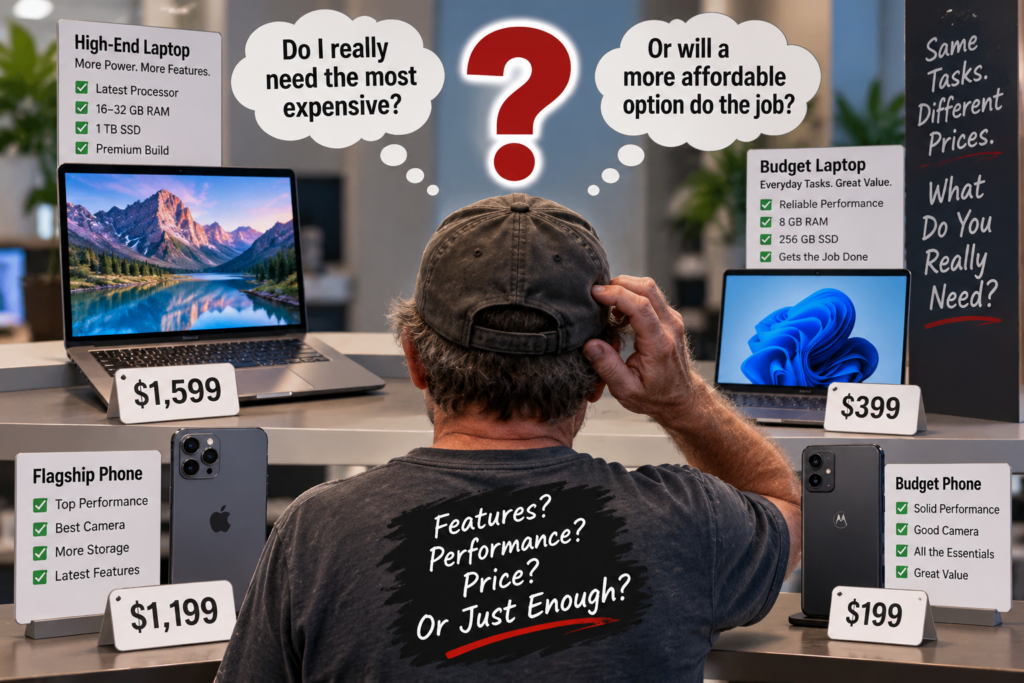
When you start talking about top-end phones, two of the names that immediately come to mind are Apple and Samsung. They are two of the major brands that are constantly advertised, and their flagship models can easily carry price tags of $1,000 or more.
But what I found when I actually started looking for a replacement is that lower-end phones, including brands or models you might not have paid much attention to before, have gotten a lot better.
And I mean a lot better. I ended up purchasing a phone for $70. That’s right, a very low-end phone after years of using top-of-the-line Android phones.
What I found surprised me.
The battery life is good, and I am able to view and use the phone without any problems. The screen is bright and easy to see, which is especially important to me because of my eyesight.
I will point out that the phone only has about 125 GB of usable storage for applications, pictures, the operating system, and everything else. That is something I’ll have to monitor, but honestly, I don’t think it is going to be a problem considering how I use my phone.
I also have no idea how good the pictures I take with it will turn out. But remember, I don’t take a lot of pictures, so camera quality simply isn’t a priority for me.
The phone hasn’t locked up on me, or at least no more often than some of my higher-end phones did.
So far, every requirement I actually have for a phone has been met. And to be honest, I don’t see that changing.
If you take a lot of pictures, then you are probably going to need more storage space. That is just a given, and more storage can increase the price of the phone you need.
The amount of memory, or RAM, a phone has can also become an issue. But for the way I use a phone, I think that requirement can sometimes be overrated. I regularly clear applications that I am no longer using. Two swipes on the screen and the apps I’m finished with are gone.
For social media, news, texting, and the other everyday things I do, I simply don’t need huge amounts of memory. Now, if you run higher-end applications that require a lot of memory, then yes, you need to plan for that when choosing a phone.
The same goes for pictures. If you take a lot of pictures and want a top-quality camera, you are probably going to pay more for it. There is nothing wrong with that if it is something you actually use.
But I feel like I learned a hard lesson here. Even for a geek like myself, I don’t need a top-end phone.
Now, let’s talk about the toughness of the phone, because this can be a very real concern.
If you work construction or have another physical job where your phone can easily be damaged, you need something that can survive that environment. If you like to jog, hike, or do other outdoor activities, you may want a phone that can at least handle getting wet.
Not all phones are waterproof, and there is a difference between water resistance and waterproofing. There are phones specifically designed to survive harsher environments, drops, water, dust, and other abuse.
And yes, once again, those features can cost more.
But that is also money being spent on something you actually need.
If you have spent the time evaluating your needs, reviewing the phones you can purchase, and reading the reviews, there is another place where you may want to spend your money: the actual phone plan.
I’m not going to go deeply into phone plans here because that could easily become another article. But I spend a lot of time on my phone and don’t always have access to Wi-Fi. Because of that, data, calling, and texting are things that matter to me.
Remember, the phone and the service are two separate expenses, especially if you purchase the phone outright.
You need to make the same kind of evaluation when choosing your phone plan that you made when choosing the phone itself. How much data do you actually use? How often are you away from Wi-Fi? How much do you call or text?
Figure out what you actually need before you walk into a store and sign a contract or agree to a plan you may regret later.
The cheapest plan may not meet your needs, and the most expensive plan may give you a bunch of things you will never use. Just like the phone itself, the goal is to pay for what you actually need.
Ok, lets now talk about what you need in a computer. This one follows the same types of evaluations that I previously made with the purchase of my phone.
My requirements are more complicated when it comes to purchasing a new computer.
Look at the title of this website: Dan’s “Geek” Stop. The “Geek” in that title is there for a reason.
I spent over 40 years of my working career doing nothing but computers. I operated them, programmed them, supported them, and worked in many other technical areas. Even though I’m retired, I’m still very active when it comes to computers.
I still program. I also take pictures with a dedicated camera, both terrestrial and astronomical. Well, I hope to get back into astrophotography.
Those are specific tasks that require more storage, more memory, faster processing, and better graphics capabilities. And to be honest, because I am so hard on computers, I also need a tougher build.
When I say a tougher build, I mean a laptop I can carry around, open and close multiple times a day, and use constantly without worrying about it falling apart. I need a keyboard that can handle the heavy-handed typing I am famous for. I learned to type on a manual typewriter, so my touch is definitely not light.
So my requirements start becoming pretty clear: more memory, a faster processor, better graphics capabilities for working with the pictures I take, and more storage for everything I want to keep.
We’ll discuss storage in a bit, because that particular requirement is actually a little more flexible.
I very much doubt that I can get everything I want in a computer cheaply, and I have been shopping around.
If I get what I really want, especially something that will hopefully last me for the long term, I’m probably looking at around $1,500 at the high end. At a minimum, I’m probably looking at around $1,100 unless I go with a refurbished computer. I’m hesitant about buying refurbished, but I’m not completely against it.
The important thing is that I feel I would actually use the capabilities I’m paying for.
Does that mean you need all that horsepower?
No, it doesn’t.
And that brings us to what I think the average computer user actually needs. When I talk to most people, they discuss using their computer for things like an office suite (yes, I can get you a free office suite), surfing the internet, watching streaming videos, checking email, and storing pictures or videos.
None of that requires the fastest processor or huge amounts of memory. You don’t even need a high-end graphics card for normal video streaming. The integrated graphics found in most lower- and mid-range computers today should handle those everyday tasks without a problem.
Storage is another area where you have some flexibility. Even if you store a lot of downloaded videos, pictures, or other large files, you can purchase a portable hard drive or SSD that plugs into your computer. That can be a much cheaper solution than paying a premium for a computer with a huge amount of internal storage.
One thing I don’t particularly like about some cheaper computers is that they don’t always give you enough ports. You may want to connect a keyboard and mouse, your phone, an external drive, or other devices.
But honestly, there are inexpensive ways around that problem, too.
So, for a normal computer user, what would I expect to spend to meet those requirements? Maybe $500 to $700.
You can certainly spend less. But when I buy a computer, I like to think about getting at least five years of useful life out of it if possible. Sometimes spending a little more today makes more sense than discovering two years from now that you bought something that can no longer do what you need.
The one recommendation I usually make is to stick with a Windows computer using an Intel or AMD processor. That’s my preference because I think that combination gives the average user more flexibility in the software and hardware they may want to use in the future.
Does everyone need that combination? No. But when I’m recommending a general-purpose computer to someone who doesn’t know exactly what they may want to do with it several years from now, I prefer to leave them as many options as possible.I’m going to make one final comment about computers.
I went from discussing my own requirements to what I think the average user would need. But none of us should pigeonhole ourselves into either category. Your requirements depend entirely on what you actually plan to do with the computer.
If you do any serious gaming, trust me, graphics, processing speed, and memory just became much more important, and the price of your computer probably went up with them.
A serious gamer can easily spend considerably more on a computer than either the $500 to $700 range I suggested for an average user or even what I have budgeted for myself. High-end gaming hardware can get expensive very quickly.
But then again, gamers are an area of geekdom all their own.