
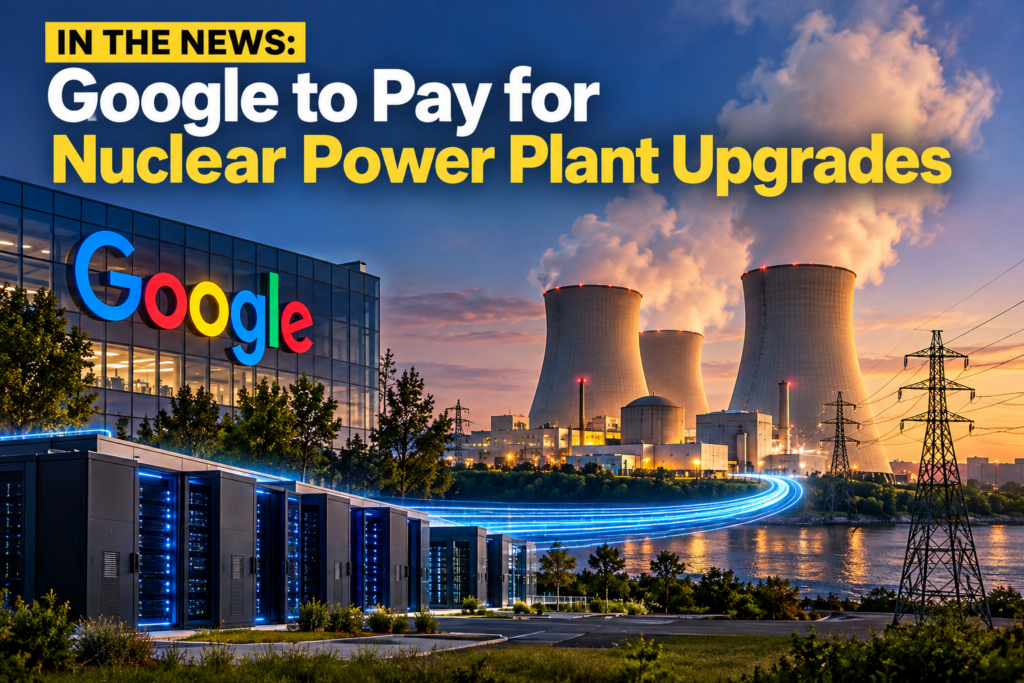
Finally, a major data center user is stepping up and taking responsibility for the electricity demands of the data centers it relies on.
Google has just announced that it will pay the full cost of upgrades to several nuclear power plants across multiple states, without passing those upgrade costs on to consumers. Why we’re backing America’s existing nuclear plants
In a number of previous articles, I have touched on the legitimate concerns people have raised about the enormous power consumption and other environmental impacts of these massive data centers.
One suggestion I have made is that these large technology companies should consider building their own power generation facilities, either on-site or near the data centers they operate.
Now, this announcement by Google does not go as far as what I have suggested. However, I believe it is a positive step in the right direction. Google is beginning to address legitimate concerns about electricity consumption and the impact its massive data centers have on the public and the existing power infrastructure.
Here is a breakdown of what Google’s announcement actually means.
Google announced a major agreement with Constellation Energy to increase electricity production at existing nuclear power plants. The goal is to meet growing electricity demand from Google’s data centers while adding generating capacity to the public electrical grid.
Key Points
- $4.3 billion in investments. Constellation will invest in upgrading 11 nuclear reactors at six facilities in Pennsylvania, Illinois, and New Jersey.
- 890 megawatts of additional electricity. That’s approximately the generating capacity of one large nuclear reactor, without constructing an entirely new plant.
- Upgrading existing equipment. Improvements to turbines, steam generators, and digital control systems will increase efficiency and electrical output.
- Google’s long-term commitment. A 20-year electricity purchase agreement gives Constellation the financial security to make these investments.
- Protecting residential customers. Google says its agreement will cover the costs of the nuclear upgrades rather than passing those costs on to other electricity customers.
- Employment benefits. The project is expected to preserve approximately 4,400 existing jobs and support 7,200 construction jobs.
- Using AI to improve nuclear operations. Constellation will use Google’s Gemini Enterprise technology to help plan upgrades, improve efficiency, and optimize plant operations.
- A broader nuclear strategy. Google also describes nuclear energy partnerships in Georgia, Iowa, and Tennessee, including restarting retired reactors and developing advanced nuclear technology.
The Bigger Picture
Google’s electricity needs extend well beyond artificial intelligence. Its data centers also support YouTube, Google Search, Gmail, Google Cloud, and numerous other services. AI is contributing to increasing electricity demand, but it is certainly not the only factor.
Another concern is the condition of America’s existing electrical infrastructure. Increasing generating capacity does not automatically solve problems involving aging transmission lines, transformers, and substations. These systems must also be upgraded to handle growing electricity demand.
Google’s announcement represents an important development because a major technology company is helping finance the additional electricity production its operations require.
While this agreement does not mean Google is building its own power plants, it is a positive step toward addressing the concerns surrounding the enormous electricity demands of modern data centers.
Now, what is even more encouraging is that Google is not the only major data center operator stepping up to address these concerns. Other large technology companies are also making significant investments in our nation’s energy infrastructure.
Other Major Technology Companies Investing in Nuclear Energy
1. Microsoft: Three Mile Island, Pennsylvania (2024)
Microsoft signed a 20-year agreement with Constellation Energy to support restarting the previously closed Unit 1 reactor at Three Mile Island, now called the Crane Clean Energy Center.
The project would restore approximately 835 megawatts of generating capacity.
This is particularly relevant to Pennsylvania because it involves bringing a retired nuclear reactor back into operation.
2. Amazon: Pennsylvania and Maryland (2025–2026)
Amazon signed an agreement for up to 1,920 megawatts of electricity from the Susquehanna nuclear plant in Pennsylvania.
The company is also exploring additional nuclear capacity, including small modular reactors.
More recently, Amazon reached a 20-year agreement involving the Calvert Cliffs nuclear plant in Maryland, including plans to increase generating capacity.
3. Meta (Facebook): Illinois (2025)
Meta signed a 20-year agreement with Constellation Energy to support the Clinton nuclear power plant in Illinois.
The agreement secures approximately 1,121 megawatts of electricity and supports adding roughly 30 megawatts of generating capacity.
It also helps keep the existing nuclear facility operating after state financial support expires.
The Bigger Picture
These companies are already making significant commitments to nuclear energy, but there are important differences between their approaches.
Purchasing electricity from existing nuclear plants, restarting retired reactors, and financing upgrades that increase generating capacity are not necessarily the same thing.
Google’s recent announcement is particularly notable because it specifically addresses adding 890 megawatts of generating capacity while committing to cover the associated upgrade costs rather than passing them on to other electricity customers.
These investments are encouraging developments, but another major concern remains: Who will pay for modernizing America’s aging electrical grid, including transmission lines, transformers, and substations?
The need to modernize America’s aging electrical grid has been a tin can that has been kicked down the road for years. And that is one of the reasons these absolutely necessary upgrades are going to be so expensive.
These improvements were needed long before the conversation about massive data centers ever began.
Forget the data centers for a moment. Our society as a whole has become increasingly dependent on electricity and electronic devices. We are way past the days when electricity was primarily needed to keep the lights on.
Today, almost every household appliance and electronic device requires electricity. Add electric vehicles (EVs), computers, smartphones, and all the other modern conveniences we have come to depend on, and our demand for electricity continues to grow.
Yet our electrical grid and power generation infrastructure have struggled to keep pace with these changing demands.
It would be easy to place all the blame on the utility companies, and I believe they absolutely deserve some of that blame. However, as consumers, we also need to accept some responsibility.
We want the conveniences that modern technology provides, along with all the new innovations that are coming in the future. But at the same time, we have often pushed back against the construction of new power plants, transmission lines, and other necessary infrastructure. We have also been reluctant to accept the costs associated with these improvements.
We cannot continue demanding more electricity, greater reliability, and newer technology while resisting the investments needed to make all of it possible.
So, what is the estimated cost of upgrading America’s electrical infrastructure? Hold on to your hats, because this number will blow your mind.
According to estimates from Deloitte, upgrading and expanding America’s electrical transmission and distribution infrastructure could cost between $680 billion and $930 billion from 2023 through 2030. These investments include replacing aging equipment, upgrading transmission lines, and expanding the grid to handle growing electricity demand. But with these major data center operators investing in power generation, this is one major expense that no longer needs to fall entirely on utility companies and consumers.
Hopefully, these investments will allow utilities and consumers to focus more attention on the infrastructure upgrades that have been so desperately needed for years.
It’s time, people, for us to stop kicking that tin can down the road! We all need to take responsibility for our nation’s energy needs. That includes utility companies, government, and us consumers.
If these major technology companies follow through on their announced investments in power generation, we need to make sure the infrastructure upgrades that have been neglected for far too long finally get the attention they deserve.