
I need to rant about clickbait for a minute before I get into the two articles that caught my interest.
Have I mentioned clickbait titles in articles before? I’m sure I have.
It doesn’t matter whether I’m pro or con on a subject. How about just being honest about what you’re actually writing about?
Don’t say, “IT IS HERE!” or “THIS IS EVIL!”
Good Lord, people, how about an honest title?
And yes, this post is about two articles that acted like “IT IS HERE!” when what they were really saying was, “We may have found solutions that have not yet been tested.”
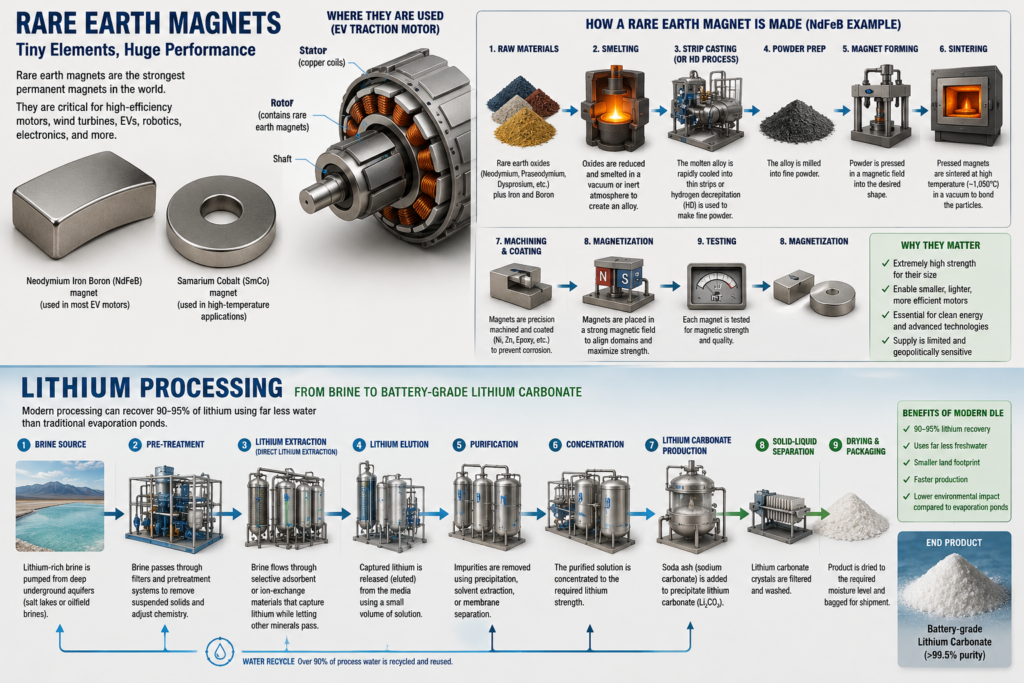
So, here we have two articles that make my point. US lab cracks the code for building powerful magnets free of rare earth metals and New method pulls 95% of lithium from salt without using a drop of freshwater.
Both titles, which were basically the same no matter where I found them on the internet, captured my interest because I thought the real concerns surrounding both subjects had finally been solved. Problem over.
I was duped. The titles are clickbait.
Not the worst kind, because they are based on real research that is showing promise. But they are still clickbait because people automatically assume, just as I did, that the problems have already been solved.
Ok, to the actual content of the articles.
Lets start with the new method for creating permanent magnets. Currently these magnets are created using rare earth materials which are very toxic when extracting the rare earth after being mined. From the article:
“Permanent magnets are a crucial part of our everyday lives. From aiding data storage to helping us drive electric vehicles (EVs) to enabling high-quality medical imaging, permanent magnets are used everywhere.”
So, any method that can be found for producing magnets that can replace rare earth magnets could be a huge game changer for two reasons.
First, there is the environmental impact, as I mentioned at the beginning of this article.
Second, China controls much of the world’s supply of rare earth minerals. The Chinese government has already shown a willingness to use that position to advance its own geopolitical goals.
I also know that the United States has untapped sources of rare earth minerals. If alternatives to current rare earth magnets can be developed, it could give us the time needed to determine how to extract and process our own natural resources correctly.
So, after reading the article itself, I found that through the use of AI and specialized modeling created for this type of research, the researchers believe they have developed a methodology for identifying promising solutions to this problem.
See why I feel the title of the article is clickbait?
I actually think what they have done may eventually give us exactly what the title suggests. But we aren’t there yet.
That’s why I wish they had been more honest with the title.
The problems have been identified, and researchers are using every tool available to find solutions as quickly as possible.
We may not have the answer yet, but this research shows that people are actively working toward one.
Now to the lithium article.
This was another clickbait headline that really upset me. Again, the processing of lithium ore is often a very toxic process that uses large quantities of water.
Just take the time someday to research how much manufacturing and industrial processing rely on large quantities of water and potentially harmful chemicals. Everything from oil refineries to chemical plants to the processing of various ores after they are mined requires significant resources.
This is hard on the environment, and we really do need to find better methods. At the very least, we should be looking for ways to reduce freshwater consumption and increase the use of recycled or gray water wherever possible.
Okay, now to the extraction of the actual lithium.
With the help of AI telling me WTF they were talking about, the core idea appears to be this:
- Allow the lithium-rich brine to dry into a solid salt crust.
- Wash that salt mixture with common organic solvents such as ethanol and acetone.
- Lithium dissolves into those solvents much more readily than many of the other salts.
- The solvents effectively separate the lithium from the unwanted materials.A solar-powered evaporation process then recovers and recycles the solvents for reuse. According to the researchers, more than 99% of the solvents were recovered.
After reading through that proposed alternative method, I’m not sure I’m sold.
To me, this still appears to be a potentially dangerous method for separating out the lithium. You are still using chemicals in the processing.
Not using water in this process is definitely a plus, but given the chemicals involved, I don’t see how they could never find a way into the groundwater.
That would be my question to the researchers.
IIn conclusion, I probably wasted too much time complaining about the clickbait titles. But I think titles like these can actually push people away from possible solutions. When you start with a headline that suggests the problem has already been solved, then go on to explain that these are still proposals or methods that are being tested, people can feel misled.
As for the articles themselves, I do see promise in what is being proposed. Of course, there are still concerns and still questions. But thankfully, the industry and scientific community are not sitting on their hands. They are actively trying to address real concerns surrounding these important minerals.
Again, they are using all the tools at hand to find solutions.
So, as I do, I suggest to you: Have faith.