
Sigh, I have mentioned many times how much I hate pollution, trash, litter, and our throwaway society that doesn’t seem to care how wasteful and harmful it has become.
One of the reasons I haven’t written about this topic yet is because there are just so many things that encompass it. And honestly, there have been so many attempts to address these issues, yet the problem is still here.
Let’s talk about what I won’t cover in this post. Otherwise, this post would end up being a book. And honestly, I don’t have the knowledge right now to address all of the options.
I am talking about pollution.
Definition of pollution:
“Pollution is the introduction of harmful contaminants or energy into the natural environment. These additions cause adverse changes, making ecosystems and living environments unsafe or unsuitable for use.”
After reading that definition, let me rephrase what I will not address. I will not be discussing industrial pollution. That would include mining, manufacturing, energy generation, industrial accidents, and all the other things I can’t think of right now.
Let’s just talk about what YOU and I contribute to the problem.
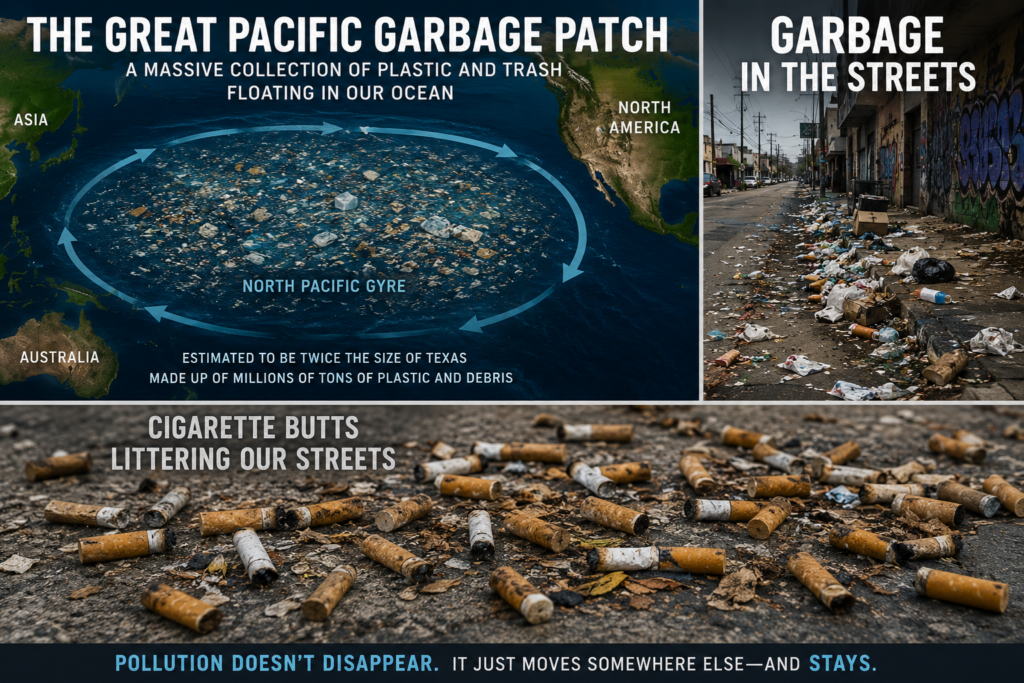
Trash, the easy one to start with. I am not talking about the trash that you and I generate where we live. We will get to that in a moment. I am talking about littering.
Soda and beer cans left wherever someone was drinking. Plastic bags from convenience stores just tossed on the street as people devour or use whatever they bought while walking down the street. Or people who simply toss trash out of their car whenever they are done with something.
People, every gas station or convenience store that I have ever been to has trash cans out the ass. They are at the pumps and by the store. Get off your lazy ass and throw your trash into one of these cans.
Christ, even worse than people just throwing their trash wherever they are, how about seeing a trash can that isn’t full, yet there is all kinds of trash laying around it because someone was too lazy to pick up whatever they missed and put it in the can?
Now let’s move to something else that I can identify with very easily: cigarette butts.
As a smoker, this is a topic I know firsthand. When it comes to cigarette butts, someone might be careful about making sure they put their trash in a trash can and don’t litter. Yet they will just flick their cigarette butts wherever they want.
Most people now smoke filtered cigarettes. Even though the tobacco and paper will biodegrade relatively quickly, the filters will not. So they just last forever.
Now, I actually carry an Altoids tin where I put my cigarette butts and then throw them in the trash when I get to a trash can. But that is something I figured out on my own. I have been in smoke shops and looked online. Honest to God, I can’t find anything like that being sold.
Now finally, let’s get to household trash.
I am not going to address recyclables because, even though there are mandated recycling programs, it seems that manufacturers and municipalities have not gotten together to simplify the process. Some plastics can be recycled, while others cannot. I just think a better job could be done, but you and I can’t really drive that other than by complaining to the people responsible for making those decisions.
I think the biggest problem with household trash is people who don’t want to pay garbage pickup fees. I have walked the streets and seen people throw bags of trash into alleys, where animals eventually get into them. I have also lived in the country, where there were unofficial trash dumps. Again, animals would get into them and spread the garbage everywhere.
Come on, people. If you can’t afford garbage pickup, at least find a legal way to dispose of your trash. Dumping it in alleys, fields, or along back roads just creates a bigger problem for everyone else. Look, trash that is not properly disposed of causes many issues. Shoot, those plastic rings that come on six-packs can cause animals to get their heads stuck in them and strangle. I actually cut mine up even when disposing of them properly.
Cigarette butts do not degrade quickly, and birds will sometimes try to eat them. Plastic, Styrofoam, and other non-biodegradable materials get washed into our water supply by rain, eventually ending up in our rivers, ponds, lakes, and oceans. Again, they are now entering our food chain.
Remember, even if you do not eat fish, that water is still used to irrigate the fields that grow the food you do eat.
I don’t have answers to these problems. Usually, when I write about something, I try to offer at least a few possible solutions. But this time, I just don’t.
The problem of pollution and trash has already changed our ecosystems in ways that we are only beginning to understand. Check this out from a very quick Google search on just one example of how our litter and pollution have changed the environment.
The rapid growth of these floating ecosystems involves several fascinating and alarming adaptations:
- The Rafting Effect: Coastal species are hitching rides on debris to travel across the oceans. Scientists studying the Great Pacific Garbage Patch (located between Hawaii and California) found that nearly 70% of plastic debris hosted diverse coastal invertebrate species.
- Rapid Reproduction: Organisms, such as shrimp-like amphipods and bryozoans, are not only surviving on the garbage, but they are also actively reproducing in the open ocean. Coastal species with asexual reproduction or direct development seem to adapt most successfully.
- A New Open-Ocean Food Web: Natural open-ocean organisms, like the blue-dragon sea slug and by-the-wind-sailor, previously relied on natural floating structures (like seaweed or driftwood). Now, they are forced to share these spaces and compete with opportunistic coastal species that dominate the garbage patches.
Ecological Consequences
While life is finding a way to thrive on the debris, this adaptation introduces major environmental risks. The introduction of coastal species acts as a vehicle for invasive species. Furthermore, animals like sea turtles and albatrosses heavily ingest this floating plastic, leading to starvation and intestinal injury.
To learn more about how organizations are managing this evolving ecosystem, visit The Ocean Cleanup or review the NOAA Marine Debris Program.
Honestly, I could go on with examples of how pollution and trash have affected our environment. But let’s bring this a little closer to home.
Let’s talk about how the plastic we throw away may be affecting our own health. This is one that I can personally relate to. Many of us have heard about microplastics being found in our food and water, but researchers are now looking at how those same plastics may be impacting our bodies, including our hearts.
Plastic trash from our everyday items never truly degrades; instead, it crumbles into microscopic “micro- and nanoplastics” that infiltrate the air, water, and food supply. Once inside the body, these tiny particles cross into the bloodstream and lodge themselves inside fatty arterial plaques, directly damaging blood vessels and significantly increasing cardiovascular risks.
1. How the Plastics Enter Our Bodies
Discarded plastics—from water bottles to synthetic clothing—break down over decades into particles smaller than 5 millimeters (microplastics) or invisible to the naked eye (nanoplastics). You absorb and consume them through:
- Ingestion: Drinking bottled water, eating packaged foods, or consuming marine life that has ingested plastic.
- Inhalation: Breathing in plastic dust shed from household items, car tires, and synthetic textiles.
2. The Journey to the Arteries
Once these particles enter the respiratory and digestive tracts, they are small enough to breach cellular barriers and enter your bloodstream.
- From the blood, these jagged particles are carried throughout your circulatory system.
- They tend to accumulate and become trapped in the fatty deposits (plaques) that line your arteries, a condition known as atherosclerosis.
3. The Threat to Heart Health
Landmark research, including a study published in the New England Journal of Medicine, revealed that plastic particles are present in the clogged arteries of a majority of surgical patients. Studies have shown that:
- Higher Risk of Events: Patients with detectable plastics in their carotid artery plaque are roughly 4.5 times more likely to experience a heart attack, stroke, or death over a three-year period.
- Direct Damage: Research shows that microplastics don’t just sit there; they directly alter and disrupt the delicate endothelial cells that line your arteries. This disruption triggers inflammation and causes immune cells and fat to collect rapidly, accelerating plaque buildup.
Reducing Exposure
While eliminating microplastics from the environment is nearly impossible, experts suggest minimizing everyday exposure by filtering drinking water, avoiding single-use plastics, and limiting the consumption of highly processed foods wrapped in plastic packaging.
For further details on cardiovascular disease links and the underlying mechanisms, you can review the full study results provided by the New England Journal of Medicine or explore the community and expert breakdowns featured on the American Heart Association newsroom.
I will wrap this up by saying that, normally, when we hear about pollution, the finger automatically gets pointed at businesses and manufacturers. And yes, they hold a lot of responsibility for these problems.
But we also need to look in the mirror and identify where we are responsible.
Most of the items that eventually become trash were developed for convenience. Our convenience. Once those products are in our hands, we should accept the responsibility of disposing of them properly.
We might not like it, but we do need to accept our share of the responsibility as well.