
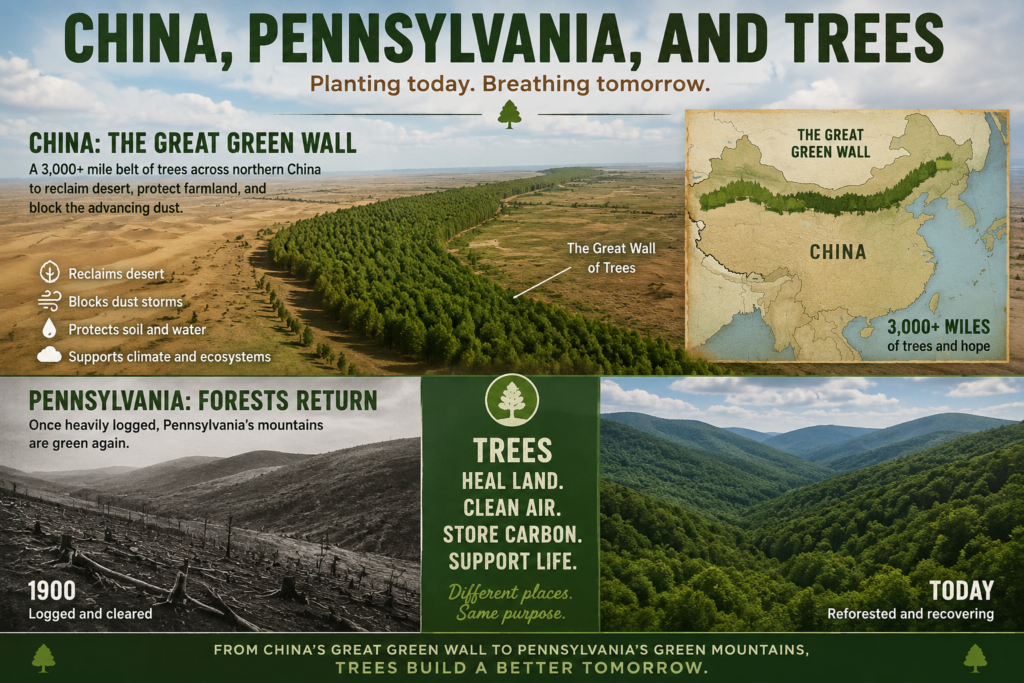
I came across an article about 66 billion trees have been planted in China’s Great Green Wall, and it made me think of a previous article I wrote about Pennsylvania’s mountains recovering after being clear-cut in Appalachian Mountains Still Powering the Nation.
Normally, you will not find me writing praise for the Chinese government, and let me be specific here: the Chinese government. But this particular effort deserves recognition. Planting trees on that scale to reclaim desert, protect farmland, and slow dust storms is not a small thing. Credit where credit is due, even when the credit goes somewhere I would not usually expect to hand it. Come on, they planted 66 billion trees. That is a boatload in anyone’s book.
I should add that China was doing this for some of the same reasons Pennsylvania reforested its mountains: recovering damaged land, protecting soil, and improving the environment. From the first paragraph of the article, here is the quote:
“Trees in China that were planted as part of huge reforestation projects appear to grow faster than those in natural forests, a new study finds. This is possibly because the reforestation trees are responding more strongly to the rising atmospheric carbon dioxide, scientists say.”
That caught my attention because Pennsylvania has its own history of cutting forests down and then watching the mountains return. Different places, different governments, different histories, but the trees are doing similar work.
As noted in the quote, there is a difference between old-growth trees and new-growth trees. The current theory is that these newer trees may be growing faster because they are absorbing more carbon dioxide from the atmosphere. The article also noted, or possibly another article on the same subject did, that these trees were not releasing the same amount of carbon dioxide back into the environment.
That caught my attention. We often talk about trees as carbon storage, but here we are seeing something a little more specific: younger forests may be reacting differently than older forests. That does not make old-growth forests less important. It just shows that reforestation can play a serious role when damaged land is given a chance to recover.
There is also mention that how these new-growth forests are managed, and what types of trees are planted, plays a major role in what scientists are observing. In other words, it is not just the number of trees that matters. The species, the location, the soil, the water, and the long-term care of those forests all affect how much carbon they can absorb and hold.
That makes sense. A forest is not just a pile of tree trunks with leaves attached. It is a living system. Plant the wrong trees in the wrong place, or fail to manage the land properly, and you may not get the same results. But when reforestation is done well, the results can be impressive.
i can hear you all now going. yea, yea, yea. What does that have to do with Pennsylvania and their their reforsting after clear cutting. Especially since Pennsylvania did their replanting back around 1808 I believe. Don’t worry, we are getting there.
During the 1800s, Pennsylvania was going through its own industrial revolution. And trust me, with steel mills, coal, railroads, factories, and everything else going on, there was plenty of carbon dioxide and pollution being dumped into the environment. Just look at old archive photos of Pittsburgh and other industrial cities from that era. In some of those pictures, you can barely see the sky.
Now think about what China has been going through with its own industrial buildup. China does not have the same environmental history, laws, or regulations that the United States slowly developed over time. From everything I have read, yes, China has been dumping massive amounts of carbon dioxide into its environment, especially during its modern industrial expansion.
That is another reason this tree-planting effort caught my attention. Pennsylvania damaged its land during industrial growth, then over time the forests returned. China has been dealing with its own industrial pollution and desertification problems, and one of its answers has been to plant trees on a scale that is hard to even picture. Different countries, different centuries, but there is a strange echo there.
The thing that jumps out at me is that I have been in many of Pennsylvania’s old industrial cities. I have seen the remains of that history firsthand, and I have a fair amount of knowledge about how this state has struggled with the environment because of its own manufacturing past.
Pennsylvania had steel mills, coal mining, railroads, factories, coke ovens, and heavy industry spread across the state. That history helped build the country, but it also left scars on the land, the rivers, and the air. So when I read about China planting trees to fight desertification, dust storms, and environmental damage, my mind naturally drifts back to Pennsylvania.
What I do not know is whether Pennsylvania used the same kinds of tree-planting strategies when our forests were recovering. Were specific species chosen? Was it managed as carefully as China’s Great Green Wall, or did much of Pennsylvania’s forest simply grow back over time once the land was no longer being cut so heavily?
I also wonder if anyone has studied Pennsylvania’s reforested mountains in the same way scientists are now studying China’s newer forests. Has anyone measured whether our second-growth forests grew faster because of higher carbon dioxide levels? Has anyone compared them to older forests the way they are doing in China?
I do not have the answer to that yet, but that is the question that keeps pulling at me. Pennsylvania and China are very different places, but both show what happens when industry, land use, pollution, and trees all collide in the same story.
Honestly, I doubt Pennsylvania monitored its forests in the same way China appears to be monitoring theirs. I do not think we had the same knowledge or technology during Pennsylvania’s reforesting period to measure things like carbon dioxide intake, forest carbon storage, soil changes, and long-term growth patterns.
But that is exactly what makes this interesting to me. I would love to see more scientific research done on Pennsylvania’s second-growth forests using modern methods. Could we compare our reforested mountains with newer reforestation efforts around the world? Could we learn whether Pennsylvania’s recovering forests responded to higher carbon dioxide levels in a similar way? Could our own mountains tell us something about how forests recover after industry, logging, mining, and pollution?
I do not know the answer. But I think it is a question worth asking.